
After Habitation
Why Culture Cannot Exist Without Community


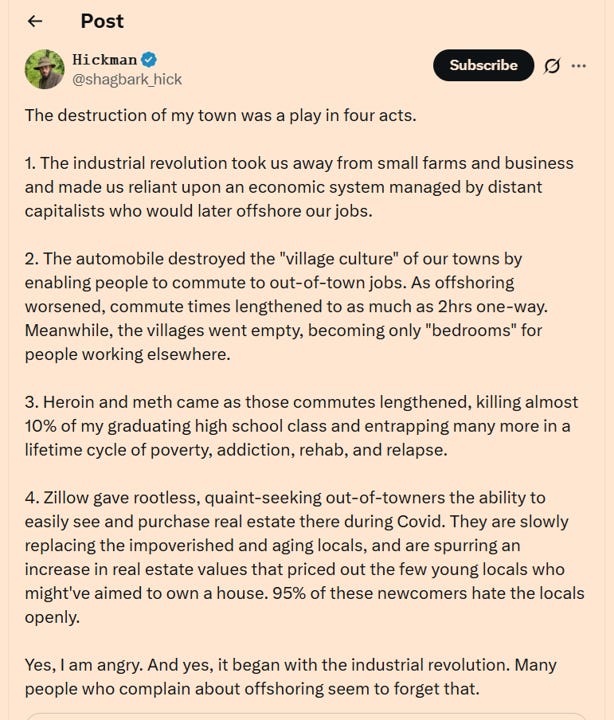
In December 2024, A.M. Hickman, the proprietor of the Hickman’s Hinterlands Substack, posted on Twitter about the ways his town had been decimated in four successive acts.
The industrial revolution took us away from small farms and business and made us reliant upon an economic system managed by distant capitalists who would later offshore our jobs.
The automobile destroyed the “village culture” of our towns by enabling people to commute to out-of-town jobs. As offshoring worsened, commute times lengthened to as much as 2hrs one-way. Meanwhile, the villages went empty, becoming only “bedrooms” for people working elsewhere.
Heroin and meth came as those commutes lengthened, killing almost 10% of my graduating high school class and entrapping many more in a lifetime cycle of poverty, addiction, rehab, and relapse.
Zillow gave rootless, quaint-seeking out-of-towners the ability to easily see and purchase real estate there during Covid. They are slowly replacing the impoverished and aging locals, and are spurring an increase in real estate values that priced out the few young locals who might’ve aimed to own a house. 95% of these newcomers hate the locals openly. Yes, I am angry. And yes, it began with the industrial revolution. Many people who complain about offshoring seem to forget that.
Hickman’s observations get to the heart of something my priest and I have been thinking a lot about recently, which is the nature of our current anti-culture, and the relationship between community and culture. Can you truly have a culture in a society where patterns of habitation are constantly disrupted at every turn? And if not, what role does community play in cultural renewal?
Anti-Culture and the Erosion of Community
As traditional Christians, it’s typical to reflect on what it’s like living in what sociologist Philip Rieff described as an anti-culture. And many things come to mind: anti-culture manifests itself in widespread violence, pornography, hedonism, abortion, addiction, atheistic education, and the relegating of religion to the personal and private sphere. But it’s possible to see all these as symptoms of a far deeper malaise. These are all symptoms of an anti-culture that can be defined, first and foremost, as a lack of community.
While the erosion of community is perhaps the most insidious manifestation of our current anti-culture, it is often the least noticeable since it has become so ubiquitous. Most of us are not old enough to remember what it was like to live in a village with a functional town square, or where it was normal to call on neighbors unannounced after work, or what it was like to dwell in communities where recreation, work, and worship were not hermetically sealed but integrated within a shared social world. We have no point of reference for what true dwelling might look like, let alone how culture is downstream of embodied habitation.
At this substack I regularly discuss the restoration of culture, including recovering leisure, promoting classical education, healthy tech use, and encouraging healthy activities among youth like sports, dance. But in this post I want to suggest that any effort toward cultural ressourcement must necessarily place community at the center. Moreover, any paradigm for cultural renewal that neglects community is not truly engaging with culture at all, but rather promoting a gnostic simulacrum of culture. This essay will be primarily diagnostic, exploring how our anti-culture has disrupted communal habitation, while hinting at the direction I will go in future essays, which will develop the argument that eucharistic micro-communities are the solution for reconstituting authentic community.
How The Modern Nation State Swallowed up Community
We are in great need of correct diagnosis, for it is no exaggeration to say that the modern world has been built on the principles of anti-community. And while Hickman is right to trace this trend to the Industrial Revolution, it actually goes back even further: the entire impetus of ideology and politics since the early modern period has been toward the creation of mono-cultures organized according to the logic of the modern nation state.
The entire impetus of ideology and politics since the early modern period has been toward the creation of mono-cultures organized according to the logic of the modern nation state, which is itself a comparatively recent innovation that emerged in direct abrogation to earlier community-based forms of social organization such as guilds, associations, extended kinship loyalties, and various forms of local organization.
Though the modern nation state is such a fixture of how we understand the world, many people don’t realize that it is a comparatively recent innovation, that emerged in direct abrogation to earlier community-based forms of social organization such as guilds, associations, extended kinship loyalties, and various forms of local organization. As Mary Harrington recently pointed out when summarizing the insight of Carlton J Hayes’ 1931 treatise Historical Evolution of Modern Nationalism,
“The nations that arose from the seventeenth century…generally weren’t ethnically homogeneous, unless you consider all European peoples to be the same ethnicity (which only makes sense from an American or Third Worldist perspective). Rather, they typically had one dominant, ‘official’ people and language, but also absorbed a cluster of other peoples and dialects, making them ‘more akin to small empires than large tribes’.”
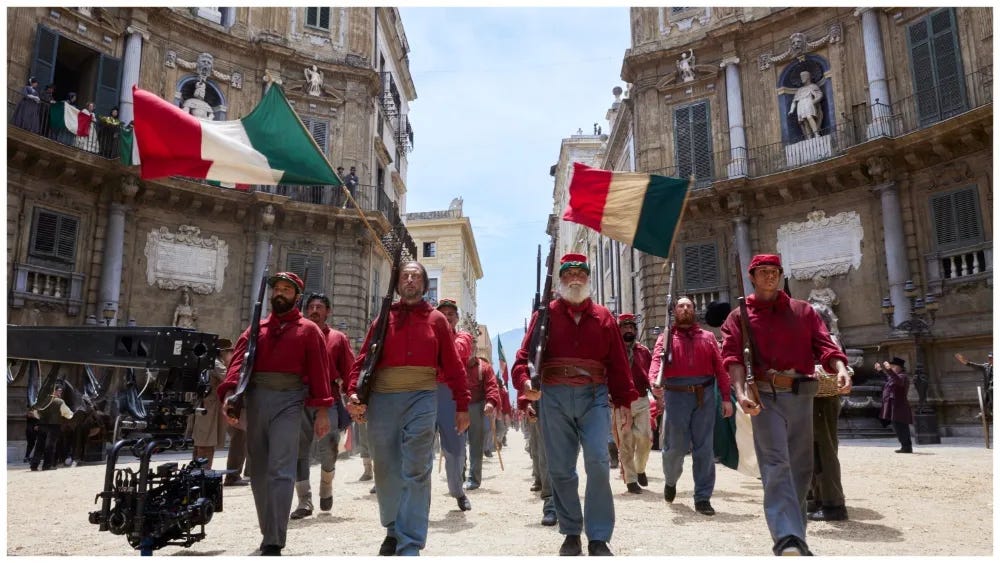
It has taken nearly three centuries to achieve societal homogenization, but that is exactly what has occurred as the logic of the modern nation state has obliterated piecemeal the ancient distinctives and associated communities. In fact, the early modern tendency of nation-states to absorb previously distinct peoples accounts for the present international political order. The nations of Germany, Spain, Italy, Romania, Russia, as we know them today—each spanning previously independent or semi-independent principalities and promoting a unified national identity and common language—largely took shape by the second half of the nineteenth century as a result of nationalist revolutions.
Even France, though it has been more or less united since the late Middle Ages, was only nominally a nation until the Revolution, as Jean Benoit Nadeau & July Barlow pointed out so vividly:
“Until the French Revolution, France was a divided patchwork of nationalities similar to the present-day Balkans. There was hardly any relationship between the Alsatians, the Flemish, the Bretons, the Basques, the Occitans, and Burgundians, the Lyonnais, the Bordelais, the Provençaux, the Corsicians, and the Savoyards. They all spoke different languages, lived in distinct geographical areas, and, of course, ate different food. Even one hundred years ago a lot of the French still spoke regional languages… France didn’t end up like the Balkans because Paris effectively bulldozed regional differences after the Revolution to create a common French identity.” Jean Benoit Nadeau & July Barlow, Sixty Million Frenchmen Can’t Be Wrong, p. 21-22
What is significant for our discussion of culture is that the modern nation state didn’t simply absorb previously independent territories; it also absorbed institutions, associations, and organizations into itself, including those that had previously been locally constituted. The full political significance of this is rarely grasped, for throughout the medieval period right through to the 19th century revolutions, power-hungry monarchs were kept at bay by community, as manifested in guilds, church, extended kinship networks, local municipalities, and powerful noble families. These all served as mediating institutions connecting people horizontally and buffering citizens from centralized sources of power. But as these institutions have gradually been either absorbed by the state, or left intact but rendered politically impotent, the fundamental relation between the individual and government has become a vertical one, with citizens existing as atomized individuals in an unmediated relationship to increasingly centralized mechanisms of power.
Throughout the medieval period right through to the 19th century revolutions, power-hungry monarchs were kept at bay by community, as manifested in guilds, church, extended kinship networks, local municipalities, and powerful noble families. These all served as mediating institutions connecting people horizontally and buffering citizens from centralized sources of power. But as these institutions have gradually been either absorbed by the state, or left intact but rendered politically impotent, the fundamental relation between the individual and government has become a vertical one, with citizens existing as atomized individuals in an unmediated relationship to increasingly centralized mechanisms of power.
Life in the Post-Community Nation
We have been ushered into a world that is lonely and where community, where it exists at all, has been emptied of public significance. Naturally this has had political implications in how we understand freedom and citizenship, but it also brings profound psychological implications. The correlate of social atomization is inner alienation.
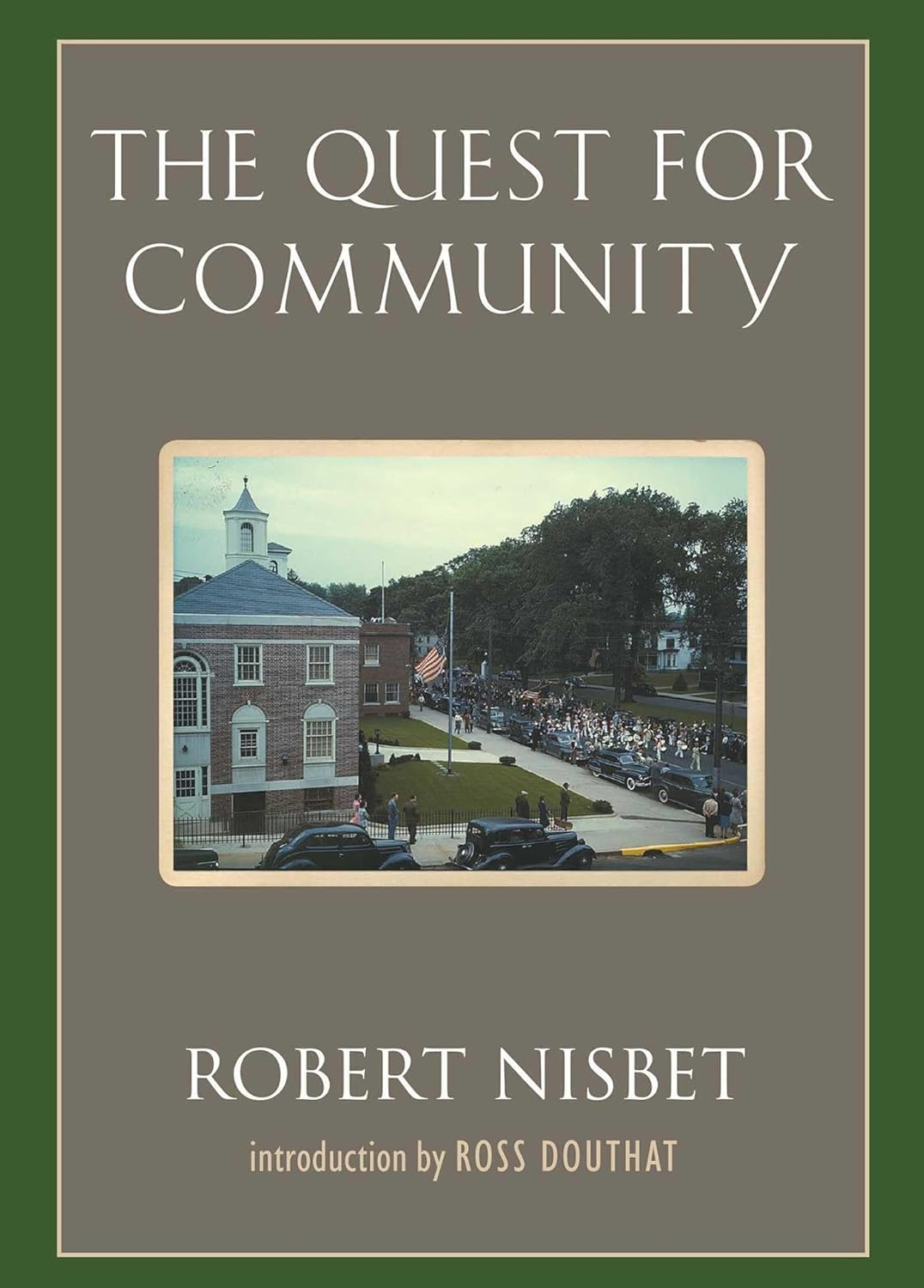
There’s a story that doesn’t often get told, which is how in the pre-modern world and even up until relatively modern times, a person’s very identity was connected to the place he or she inhabited, which itself was nested within various overlapping social groups and associations. Robert Nisbet tried to foreground that story in his 1953 work The Quest For Community. He pointed out that as webs of obligation, belonging, and mutual responsibility that once sustained local life have been dissolved by modern governments, individuals have been left socially isolated, existing in an unmediated relationship to the nation state.
“The real conflict in modern political history has not been, as is so often stated, between State and individual, but between State and social group… The conflict between central political government and the authorities of guild, village community, class, and religious body has been, of all conflicts in history, the most fateful. From this conflict have arisen most of the relocations of authority and function which have formed the contexts of the decline of medieval communalism and the emergence of both individual and central political power.” pp. 100-101
“The real significance of the modern State is inseparable from its successive penetrations of man’s economic, religious, kinship, and local allegiances, and it’s revolutionary dislocations of established centers of function and authority.” (From the Preface)
“The rise and aggrandizement of political States took place in circumstances of powerful opposition to kinship and other traditional authorities” p. 99
These “traditional authorities” that Nisbet references did more than merely limit the state’s power; they connected people horizontally in a web of pre-political bonds that facilitated social belonging in ways that, as moderns, we can scarcely conceive. Despite the potential for abuse and corruption, these localist bonds—which included everything from guilds to patronage systems to fraternities, to networks of dependence—connected people in familial-type networks. These have steadily been dissolved or neutralized by the growing preeminence of the modern nation state, leaving individuals socially isolated and standing together in an unmediated relationship to the nation state.
We even see this shift in how we talk about a citizen and a subject. In the Middle Ages, a “citizen” was an inhabitant of a free town, and this was a category distinct from the same person’s status as “subject” of the king. Today, as the nation state has absorbed all mediating institutions, citizen and subject have been conflated.
“In the Middle Ages, the citizen was literally the inhabitant of a free town. His status under the king, however, was that of subject. The two statuses were sharply distinguished then, and even at the end of the sixteenth century, in the writings of Bodin, we may see the continuation of this distinction. But in the modern history of politics, especially since the Age of Revolutions, the clear tendency has been for the terms citizen and subject to become virtually synonymous. The frame of reference has changed from the town to the nation as a whole, and the citizen is the atom-unit of the political association of the State.” Robert Nisbet, The Quest For Community, p. 100
Even in pre-revolutionary America, individuals existed within a patchwork of relationships and communal obligations that flowed down from the monarch at the top. The obligations to those above you or below you in the hierarchy created a safety net more effective than anything we can imagine in the modern welfare state. At least, that is part of Gordon Wood’s thesis in his 1991 Pulitzer Prize winning book The Radicalism of the American Revolution. Wood shows that people generally accepted inequalities because of the comfort of existing within communities structured around relationships, where everyone was linked in a web of local connections.
“Authority and liberty flowed not as today from the political organization of the society but from the structure of its personal relationships. In important respects this premodern or early modern society still bore traces of the medieval world of personal fealties and loyalties out of which it arose… The inequalities of such a hierarchy were acceptable to people because they were offset by the great emotional satisfactions of living in a society in which everyone, even the lowliest servant counted for something. In this traditional world, ‘every Person has his proper Sphere and is of Importance to the whole.’ [Hume] Ideally, in such a hierarchy no one was really independent, no one was ever alone and unattached. Hence followed the fascination of the eighteenth century with the fate of isolated individuals, like Robinson Crusoe, strangers without relatives or connections cast alone in the world.” Gordon Wood, The Radicalism of the American Revolution, p. 11 & 19
This web of local connections in pre-revolutionary America provided a sense of belonging and habitation that was carefully guarded and, if necessary, enforced. It seems unthinkable to us, but if someone left his town, he could be forcibly conveyed to his hometown.
“Both the New England towns with their ancient ‘warning out’ regulations and the southern colonies with their vagabond legislation expected everyone to belong somewhere, and they used the force of law to maintain their inherited sense of community. Under the warning-out laws, for example, towns could legally eject ‘strangers’ and have constables convey them from town to town until they were returned to the town where they legally belonged.” Gordon Wood, The Radicalism of the American Revolution, p. 20
Wood’s larger point is that the nation state that emerged out of the American Revolution was truly radical insofar as it wiped out this older system of embodied belonging and habitation.
From Belonging to Bureaucracy and the Abstraction of Social Life
A similar process to what Gordon Wood describes happening in the United States also unfolded in Europe after the nineteenth-century revolutions. These revolutions, which strengthened the idea of a central national identity, culminated in World War I, which finally swept away the remnants of medieval fealties and local community loyalties that had persisted, though often embalmed, even after the rise of early modern nation-states. In that older world, political bonds emerged out of community loyalties—loyalties to people in my community and aristocratic families. Indeed, prior to the nationalism of the early modern period, conflict between “states” really meant conflict between ruling aristocracies. But in the interval between the 19th century revolutions to WWI, these intermediate loyalties were gradually replaced by mechanisms of allegiance that were fundamentally bureaucratic and abstract. The problem is that political bonds structured around what Max Weber described as the progressive rationalization and bureaucratization of social life, do not naturally command loyalty in the same way that local community does. Hence the modern state must compensate for this through the unity manufactured through war, or through the quasi-deification of the nation state.
Political bonds structured around what Max Weber described as the progressive rationalization and bureaucratization of social life, do not naturally command loyalty in the same way that local community does. Hence the modern state must compensate for this through the unity manufactured through war, or through the quasi-deification of the nation state.
As intermediate institutions have been neutralized under the growing preeminence of the nation-state, society has been reimagined as a collection of isolated individuals whose primary—and often only—meaningful relationship is to an impersonal administrative apparatus. We saw this conceit on full display with President Obama’s “The Life of Julia” campaign, which walked us through a fictional woman’s life, from birth to death, showing how government-dependence enabled Julia to achieve a near fairy-tale existence without reference to any relationships or community (with the exception of a “community garden” where Julia worked in retirement). It was a lonely vision in which community was replaced by bureaucracy. Obama’s Julia advertisement gave us a close up view of a paradox that lies at the heart of the modern political project, namely that individualism and authoritarianism cross-fertilize each other in their mutual antagonism to human community.
This individualistic conception of the human being is deeply unsatisfying, for it perpetuates the conceit that we can ignore the inescapable role that non-governmental institutions (i.e., family, church, fraternity associations, neighborhoods, guilds, extended family groups) play in human flourishing. In this social void, the nation state offers manufactured bonds that are ultimately artificial because dependent on the increasing bureaucratization of social life.
The Vanishing Neighborhood and the Suppression of Community
We know in our bones that there is a different type of life. Tourists come from thousands of miles to visit old towns built in Christian Europe during the Middle Ages, often without even fully understanding what attracts them to these spots. Yes, we like them because they are old and historic, but even more fundamentally, whether we realize it or not, old European towns attract us because all the elements—from winding cobblestone roads to marketplaces to city gates to village commons—fosters community. Streets and the squares designed to be active public places have a humanizing pull that is remarkably strong, even when they no longer function as living centers of shared communal life, just as historic churches attract us even when they no longer function as vibrant places of worship.
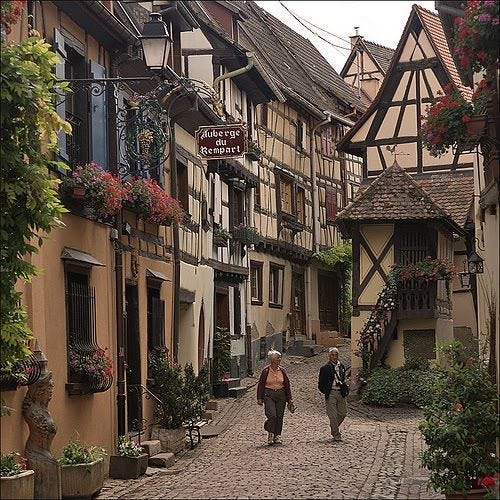
By contrast, today’s neighborhoods and cities that once fostered community have become places that isolate us from one another. Many people tell me, not simply that they don’t know their neighbors, but that if they were to take steps to meet their neighbors, that would be considered highly weird. Gestures of goodwill to people on one’s own street risk getting oneself labelled as a creep. Through automatic garage doors, we can enter and exit our house literally without ever having to step foot in our neighborhood, and many people go years without even knowing the names of people two or three houses adjacent.
This is a picture of where I live, and though they’ve tried to create an old-fashion city vibe that is not lacking in aesthetic appeal, people are effectively warehoused together without any real sense of communal life. If I were to open a coffee shop or create a town square or a place of worship, I could face civil penalties, and ultimately even arrest, because city planners have deliberately worked to separate living from work, and work from leisure, and leisure from worship.
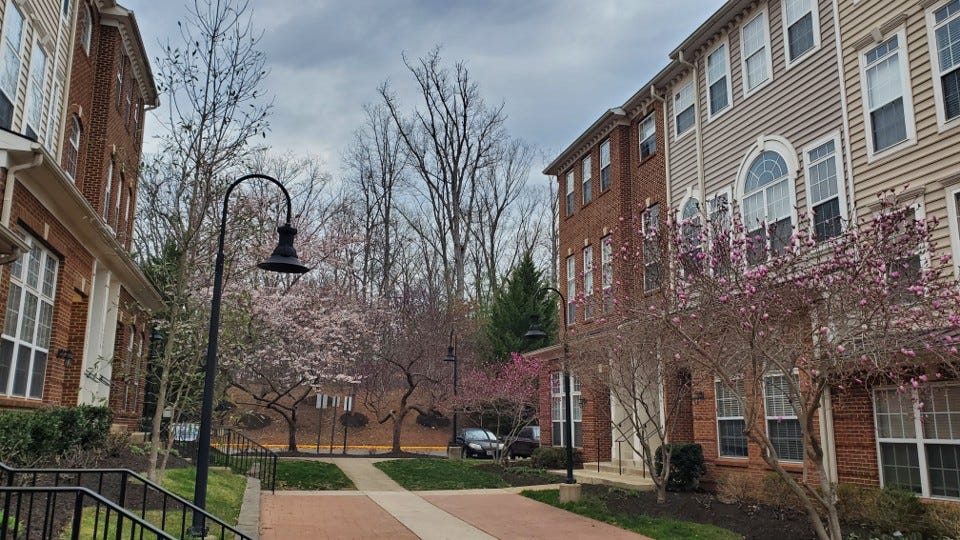
These types of anti-communal neighborhoods and cities do not spring up naturally. If left to develop organically, humans inevitably design city streets, villages, and neighborhoods to accommodate shared public life. What we have today is the result of thousands of political and economic choices, including numerous rules and artificial impositions, that collectively suppress the natural impulses of humans as social creatures, and follow the inexorable logic of the nation state in rendering local public life impotent. From Lyndon Johnson’s “Great Society,” which bulldozed neighborhoods in the name of progress, to economic policies hostile to small businesses, to so-called urban renewal schemes that separate work from living, to the growing logic of the modern nation state, we now live within a political, economic and regulatory ecosystem inimical to genuine community. The common factor in this regulatory ecosystem has been to facilitate what Philip Bess refers to as “that shrinkage of the public realm happening reciprocally and in tandem with America’s growth industry, the care and tending of the autonomous self.” Bess, who is Professor Emeritus at University of Notre Dame, goes on to note that:
“Like the decline of the street and square as active public spaces—and the demise of the alley, the ubiquity of the driveway, the transformation of the garage door into the front door, the demise of uninterrupted curbs on residentials blocks, the relocation of domestic life to yards and family rooms at the rear of the house, and the creation of complex suburban roofs apparently intended to simulate small villages—the growing number and importance of domestic bathrooms and bedroom suites indicates yet another way we materialize in our built environment our culture’s turn from the civic to the private.” Philip Bess, Till We Have Built Jerusalem: Architecture, Urbanism, and the Sacred, p. 34
To be sure, the vestiges of community still exist today, but they have migrated around amenities (the gym, swimming pool, coworking lounge), or affinity groups centered around entertainment (sports, music, etc.). Even in some rural communities where the echoes of authentic social cohesion still linger, technology is isolating the younger generation from any deep awareness of mutual dependence, as the omnipresent digital ecosystem reinforces the myth of self-sufficiency and radical autonomy. When universities, or malls, or Starbucks, make a nod toward the need for communal bonds, it often feels that community is just one more therapeutic add-on in the ongoing quest for self-actualization.

Can Culture Exist Without Community?
Where does this leave us as a culture? Can you have a culture without community? Can a true culture exist within a society structured around political and economic conditions antithetical to community?
If we attend to the etymology of the work “culture,” we find that community is intrinsic to it. Culture, in the original sense, is a place we inhabit—a place we inhabit sufficiently to cultivate it even as a farmer tills his field. As Edward S. Casey observed when defining culture,
“The very word culture meant ‘place tilled’ in Middle English, and the same word goes back to Latin colere, ‘to inhabit, care for, till, worship’ and cultus, ‘A cult, especially a religious one.’ To be cultural, to have a culture, is to inhabit a place sufficiently intensely to cultivate it—to be responsible for it, to respond to it, to attend to it caringly.”
Notice the relation between habitation and cultivation. When we inhabit a culture and have a sense of responsibility for it, then it becomes a place we attend to with art, institutions, ceremonies, festivals, local traditions, worship—in short, all the things that come to mind when we think of culture, and all the things we seek to defend from the forces of chaos and barbarism.
Because culture is particular to a people, to a land, to time and place, and to a shared public life particular to a locale, to talk of living in a culture presupposes that you are, in fact, inhabiting a place. Yet with the shrinkage of shared public life, modern man increasingly does not truly inhabit places in any meaningful sense. For many of us, growing up in large cities, or the suburban sprawl of metropolitan centers, or what is often called “middle America,” one place is largely undifferentiated from another. This means that the things that tie us to the land—including shared public life particular to a locale—become tenuous and fungible, with the consequence that we are not truly “inhabiting” the places we live in a real and meaningful sense.
Given that habitation is intrinsic to culture, if patterns of habitation are disrupted, so will our experience and understanding of culture itself. And thus we see that today culture has become an abstraction since disconnected from embodied community within particular locales. A case in point is that, within the modern context, to the extent that culture is incarnated in customs, rituals, and institutions, these tend to be the institutions and traditions of mass mono-culture, without any intrinsic relationship to real embodied community. Even when this mono-culture is subdivided into affinity groups—such as youth culture or consumer subculture, or ideological tribes—these occur within the matrix of largely disembodied consumption networks possessing no organic relation to actual physical community. Christians often speak of “taking back the culture,” but this too is usually referencing a detached mono-culture (i.e., the national or transnational institutions of media, politics, music, literature, and so forth) with no necessary connection to embodied communities in time and place.
Often when we are part of embodied local communities, these tend to be dislocated from land and thus ultimately fungible: we might have a community at our gym, another at our children’s school, another community with our work colleagues. And often our church community becomes just one more micro-society for self-expression, ultimately reinforcing rather than challenging the erosion of genuine community that has become the fundamental hallmark of our anti-culture. To the extent that we behave differently within these various micro-societies, we often internalize within our psyche what Zygmunt Bauman described as “liquid modernity.” Inhabiting multiple compartments fosters a kind of spiritual, intellectual, and emotional vagrancy, contributing to divided loyalties, and deepening the fragmentation and dislocated attachments that underlie so much of the contemporary malaise.
Remember the definition of culture, how cultivation is linked to inhabiting a place. To inhabit a place is more than just residing somewhere—it is to be part of the community tied to a place; it is to have one’s identity tied to community in a way that is sufficiently intense to incentivize community-members to care for and cultivate their shared spaces with institutions, art, beautiful buildings, inspiring public works, traditions, festivals, civic customs, sacred sites, and local traditions.
Robinson Crusoe knew he was lacking in community, but our technological dependence has created forms of fake connection and disembodied forms of digital community. And while these may certainly help to ease the alienation of life in an anti-culture, often our virtual connections merely burrow us deeper into the loneliness that is the hallmark of life in the anti-culture.
Can Inner Wholeness Exist Without Community?
This lack of real habitation lies at the heart of our anti-culture, and is a source of deep alienation. In his recent book Liturgies of the Wild, Martin Shaw observes that in the Celtic world, there was an old belief that “if you aren’t wrapped in the cloak of story and the cloak of place then you are liable to experience huge rushes of angst as you age.” (pp. 3-4)

Shaw’s observations cohere with other thinkers, such as war journalist Sebastian Junger, who argued convincingly that community belonging is key to buffering us from mental illness. (Tribe: On Homecoming and Belonging.)
These and similar thinkers suggest that, just as community protects us from power-hungry rulers by animating mediating institutions, so embodied community also protects us from forms of psychological disintegration. This includes, I would add, confusion about identity. Once organic communities are replaced by mass culture, is it any wonder we see so many people confused about who and what they are? As Kelly Kapic observes in You’re Only Human, it is only in community that we can truly find ourselves, given that we know ourselves only in relationship. Kapic observes that “historically—and it is still true today in much of the non-Western world—the default way people viewed themselves (the ‘self’) was through their social relations.” He continues,
Identity was essentially found through social and physical locations and networks rather than through introspection. Questions of identity were less about solitary figures and far more about communities and connections. Who you were was all about whose you were (your parents, clan, land, etc.).
Kapic’s observations coheres with the Eastern Orthodox writer, Metropolitan Anthony Bloom, who reminded us that “we know nothing and nobody except through a relationship,” adding,
If we are disconnected nothing exists for us…. In referring everything to ourselves we deform it and make it as small and mean as we are, with our small mean cravings.
The Unresolved Wound
The erosion of true community left an unresolved wound of alienation that formed the backdrop for the great political heresies of the twentieth century. Both Communism and Fascism were attempts to address the breakdown of community: Communism, by relocating communal bonds in the state; and Fascism, by offering a blood and soil nationalism that sought a recapitulation of primitive tribal bonds as the fundamental organizing principle for society.
Both Communism and Fascism were attempts to address the breakdown of community: Communism, by relocating communal bonds in the state; and Fascism, by offering a blood and soil nationalism that sought a recapitulation of primitive tribal bonds as the fundamental organizing principle for society.
The post–World War II liberal order has been defined primarily in opposition to these political heresies; consequently, for a long time, liberty could be articulated by negation (for the right, not Communism and for the left, not Fascism) without being coordinated toward a positive cultural telos (and often in direct opposition to teleological understandings of freedom). But as the 20th century recedes from living memory for many, the basic problems that Communism and Fascism sought to address are reemerging in new configurations and misguided solutions, from tribalism and identity politics on the left, to the vitalism and nationalistic identity politics on the right. The unresolved wound remains the erosion of community.
What does this disintegration mean for us as believers? Clearly, if we are to disciple the nations (thus their cultures), and if we are to create a culture of life instead of a culture of death, then the recapitulation of community will be at the heart of this endeavor. Without community, there can never be true culture. This is a theme I hope to take up in a follow-up article. I will suggest that this conflict between community vs. anti-culture is none other than the age-old war between the City of God vs. the City of Man, and between Eden vs. the Tower of Babel. My argument will be that community is restored in the Eucharist, though the work of allowing the sacraments to heal this unresolved modern wound does not happen automatically, but requires sustained effort, as we allow the sacramental vision of community to flesh itself out in all the nooks and crannies of parish life.
This is fascinating stuff and I wholly agree. Recently I read a book about an English parish (Morebath) at the time of the Reformation in the 16th century. The people pretty much "owned" the church and while it didn't have formal guilds, it did have multiple small associations whose purpose was to supply candles for images of saints, supply for the needs of the church and raise money to support it and its people generally. These groups were a web of support and discipline, with clear expectations of each member of the community as they included things like serving the church in an official capacity of some kind for a period of time. The State, in imposing the protestant religion, gradually broke all those bonds, leaving its people subject to the whims of their rulers and also impoverished. This made them more reliant on the state, which was the goal. It should be recognised that king Henry VIII abolished certain feast days in the English church as he thought the people were having too many holidays and not working hard enough - that's where the modern world started.