

In the previous article we explored the historical and philosophical pedigree whereby ethics became a field detached from the rest of life. We discussed the separation of facts from values, and the partitioning of ethical reasoning from our understanding of human nature and the purpose of existence. The result, I suggested, is an ethical landscape dominated by seemingly endless moral dilemmas and competing theories, with no shared framework for adjudicating between opposing ethical assumptions.
I explained how in the ancient tradition of ethical inquiry—whether Hebrew, Chinese, Greek, Roman, or early Christian—ethics was primarily about persons, and only secondarily about actions. Among the fundamental questions of moral philosophy were:
What kind of person do I want to become?
What does a flourishing human life look like?
Within the ancient world, the answers to these questions always involved some account of the virtues: qualities like courage, kindness, wisdom, honesty, integrity, temperance, patience, etc. While not everyone agreed on what constituted virtue, there was a common consensus that through dutiful habits, educational formation, and proper spiritual practices, we can develop the right attitudes and traits necessary to become well-ordered and mature human beings.
So rather than beginning with the question, “What should I do?”, the ancient tradition of ethical inquiry begins by asking, “What kind of person do I want to become?” As such, the virtue tradition connects character with vocation and thus to human flourishing, and to the character-forming habits that lead to character.
I also suggested that by looking at the goods internal to particular roles, we come to the question, “What is the good for human beings as such?” Ultimately, this requires a truth about the Good—a metaphysical horizon of ultimate Goodness that animates and gives coherence to our desire for finite goods.
Once ethics is grounded in this larger vision of reality, then ethics is no longer an abstract system of rules imposed upon life, but an integral part of learning how to become the kind of people we were created to be—the best version of ourselves.
Again, you can read or watch that earlier lecture by visiting my Substack essay, “When Ethics Lost the Good: How the Enlightenment Separated Morality from Human Flourishing—and Why Virtue Offers a Way Back.” Or you can listen to the my interview with the virtue ethicist Dr. William Kabasenche below.
Now I’d like to build on the previous work by looking at application, specifically the cardinal and theological virtues, and the role that virtue plays in training the emotions, so that each one of us can become the best version of ourselves.
In the process, I’ll be debunking certain myths and misunderstandings about virtue, including:
the myth that virtue is primarily about individual self improvement
the myth that virtue should be hard
the myth that virtue is primarily about doing rather than desiring.
We’ll also deal with some misunderstandings about certain virtues. We’ll learn why:
patience isn’t just about waiting peacefully
how temperance is about more than responsible drinking
how gratitude is a choice.
We begin by asking, “Why be virtuous?”
Why Be Virtuous?
Many people would say we should be virtuous because we simply ought to, where “ought” is understood in a specifically moral sense. But in my previous lecture I argued that there is no specifically moral sense of ought because if you detach morality from all the other departments of life then there is nothing meaningful left. Rather than imagining a realm of detached morality, we should understand that our moral obligations arise from the goods toward which human life is ordered. Thus, the answer to the question, “why be virtuous?” is “so I can flourish and achieve my primary telos in God.”
So virtues are the qualities and character traits that enable us to pursue the goods proper to human life. The obligations associated with a virtuous life are not arbitrary rules imposed upon us from outside, but necessary for developing dispositions that help us become the kinds of people we were created to be. Actions lead to habits, and over time habits lead to character traits, and these traits enable us to become a flourishing man or woman—to have well-ordered desires, impulses, judgments, and reflexes that order us to the Good. (For more about the power of habit, see my article “The Power of Baby Steps in a Superman Culture.”)
And we need help doing that because we are broken and have hearts that misdirect us. Consider how, at the fall, the human race became disordered, leading us to follow the passions instead of God. The passions do more than merely make it impossible for us not to sin. The passions corrupt us from achieving our proper end—they dehumanize us.
An analogy I used, when discussing this for my book Rediscovering the Goodness of Creation, is the sea turtles featured in the documentary Planet Earth II.
This documentary showed a type of turtle that hatches from its egg on the full moon at Barbados beach. By following its instinct to head toward the light of the moon, the baby turtle will quickly reach the safety of the ocean. However, in recent times, the lights of a nearby city—often appearing more accessible and immediate than the moon’s light—have lured these turtles away from their proper destination. The result is that increasing numbers of turtle hatchlings never make it to the ocean but wander confusedly in the city streets until finally perishing.
Significantly, it is precisely because of the turtles’ primordial longing for the moon that they find the artificial light of the city so alluring. Their God-given affections are being misdirected by the lights of the city so that instead of following the way of life they follow the way of death.


This is analogous to how we behave as fallen men and women. It is precisely because we retain the elemental longing to seek Divine Beauty and eternal joy that we find finite beauties and temporary joys so accessible and compelling. The counterfeit beauties that enslave and entangle us would have no allurement if we were not designed to flourish through union with Divine goodness, truth, and beauty. For example, the lure of counterfeit wisdom—in everything from the tree of the knowledge of good and evil, to occult knowledge, to the mysticism surrounding information technologies—would have no appeal if we were not designed to feed on ultimate Truth, namely God Himself. The lure of addictions and carnal pleasures that we think will be good for us right now, and which promise an immediate happiness, would have no pull if our hearts were not designed to feed on the happiness of ultimate Goodness. The false happiness of sin appears more accessible and immediate than the blessedness of union with God. And so we wander confusedly from one passion to another until finally perishing.
This perspective can reframe how we think about sin. The problem with sin is not primarily rule-breaking, but disordered affections. Rule-breaking is a symptom of disordered affections. In our Edenic state, before our desires became disordered, there would have been no tension between finite beauties and Divine Beauty, nor between natural human desires and the desire for God. But the disordering effects of sin introduced fragmentation into human experience, with the resulting illusion that satisfaction of finite longings can function as stand-ins for the primordial desire for God Himself. As St. Augustine put it so well, God has made us for Himself and our hearts are restless until they rest in Him.
During the filming of Planet Earth II, the film crew had been strictly instructed never to interfere with the nature they were documenting. But in the case of the helpless turtles, crewmembers rebelled. They were so traumatized by what they saw happening to the helpless creatures that they assisted members of the Barbados Sea Turtle Project to rescue the hatchlings

This is like what Jesus did for us when He came and died for our sins. Through His death, resurrection, and ascension, and then His sending of the Spirit at Pentecost, He enabled us to be redirected back to our natural homeland. And He gave us the Spirit and the Sacraments so that we might live according to the true light of the virtues rather than the false light of passions. The virtues enable us to flourish—they redirect us to our proper end, which is beatitude in God. Through the virtues, our affections are gradually being healed so we follow the way of life rather than the way of death.
Virtue and the Healing of the World
When we practice the virtues as an outgrowth of the salvation Christ purchased on the cross, then the virtues become part of our healing, transformation, and deification—and even more, our own healing becomes part of the process whereby God is healing the whole world, from the parish community to the cosmos itself.
And that means that virtue is about more than just you and me—it’s about the healing of our world through the healing of our communities. When we are redirected to our proper telos (like the sea turtles were redirected to the light of the moon) then other people follow us. You probably know that from your own experience being around people who radiate the virtues—such people have an almost magnetic attraction; they show that a virtuous life is not just good, but beautiful and attractive.
When we cooperate with the work of the Spirit who is cultivating virtues in us, not only do we become better versions of ourselves, but we become better friends, better spouses, better parishioners, better parents, better children, better employers, better employees, and better co-workers. The virtues enable our relationships to thrive in community because they give us the freedom to love.
This is something I’ve really appreciated about Edward Sri’s book The Art of Living. This is a very good book about the virtues, and it’s very practical with lots of helpful examples. Notice the subtitle, “The Cardinal Virtues and the Freedom to Love.” Sri emphasizes that the virtues are not just about ethical self-improvement but they give us the freedom to love—they free us from the passions that would hinder us producing and participating in loving community life.
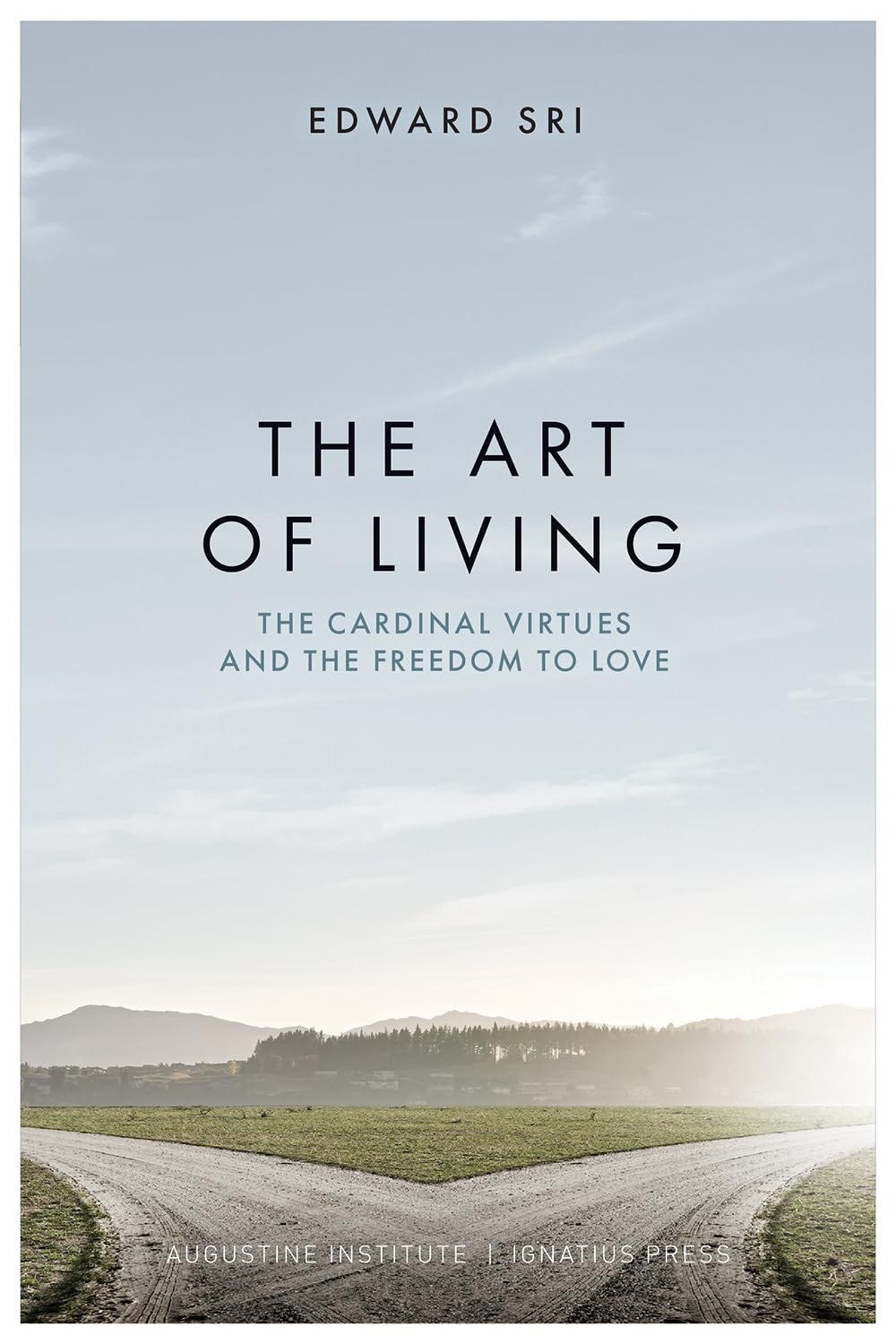

I cite from the book:
“The Virtues are the basic life skills we need to give the best of ourselves to God and the people in our lives. In short, virtue gives us the freedom to love…
When I was younger and heard people at church talk about the virtues, I had an individualistic view of the virtuous life. I had the mistaken impression that virtue was something good for merely my own soul: for my moral development or my spiritual life. Humility, piety, kindness, prudence, temperance—these and other virtues seemed to be simply good qualities every Catholic was supposed to have in order to be a good Christian. Virtues were like badges that made you a good ‘Boy Scout’ for God.
Virtue, however, should be understood relationally. The virtues are not important for merely one’s own life; they are the habitual dispositions we need to love God and the people God has placed in our lives. Virtue gives us the freedom to love. When we possess virtue, we have the ability to give the best of ourselves to God and others. And our lack of virtue in certain areas doesn’t harm just us; it negatively affects the people close to us. They will suffer the consequences of our lack of virtue… If I am prone to being discouraged, overwhelmed, or anxious, I will tend to be focused on myself—my troubles, my fears, my decisions—and likely transfer my stress to others and be unable to give the best of myself to the people around me.
This is the most tragic thing about my deficiency in virtue; to the extent that I lack in virtue, I am not free to love. No matter how much I may desire to be a good son of God, a good husband to my wife, and a good father to my children, without virtue—the fundamental dispositions that enable me to love—I will not consistently give the best of myself to them.” pp. 2 & 17-18
So the virtues are the life skills that enable us to flourish in relationships and community—not only our relationship with Christ, but those around us. To see how this works out, let’s jump in and explore some specific virtues.
There are different ways of categorizing the virtues and sub-virtues, but I am using the system laid out in Edward Sri’s book, which he got from Aquinas, who was of course following earlier thinkers. These thinkers categorized certain virtues as the cardinal or hinge virtues on which everything else depends. These are prudence, justice, fortitude, and temperance. These are the virtues on which our lives swing, like a door on its hinges.
And each of these virtues comes with a collection of sub-virtues.
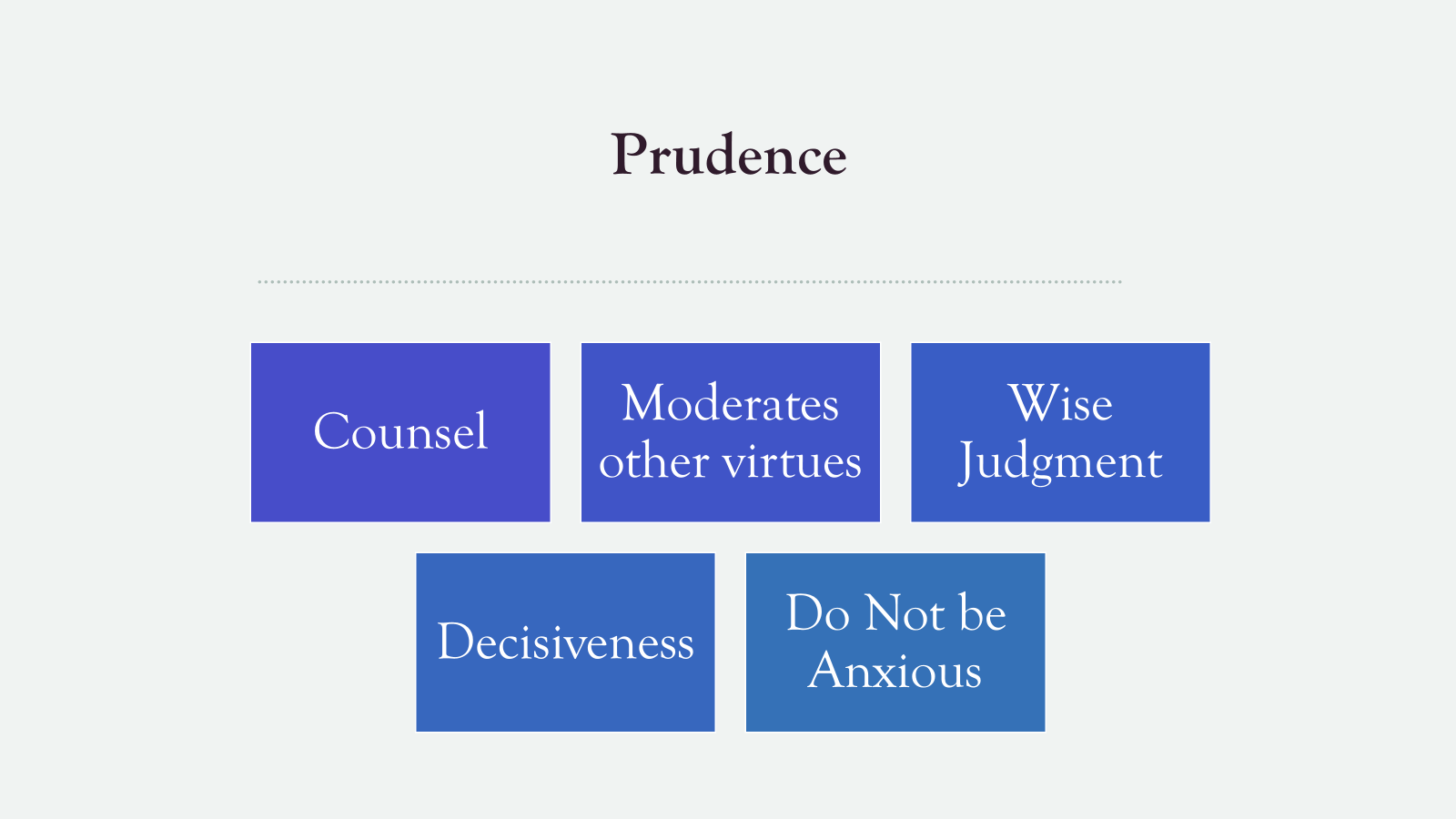
Prudence
Here you can see that Prudence includes sub-virtues of counsel, wise judgment, decisiveness, and not being anxious.
Prudence is one of my favorite virtues, although I’m not very good at it. It has to do with seeing ahead, exercising sagacity and wise judgment. It’s about the types of competencies described in the book of Proverbs where someone is able to act wisely by being a student of men, animals, and the natural world.
Prudence is basically the virtue of doing practical reasoning well. The word “practical” in “practical reasoning” is important. Ethics is not like doing a geometry problem where you simply have to know all the principles and then apply it in the world. Some Christians mistakenly think of ethics like that. But simply knowing the good isn’t enough. Knowing the end you want to achieve isn’t enough. And having right principles also isn’t enough. We have to know how to wisely apply our principles in the complexities of messy situations; we have to wisely determine the means for reaching the right ends. We have to know how to pursue the good within all the complexities of our unique circumstances and roles. All this requires practical reasoning. This is where intelligence, creativity, experience-shaped intuition, all come into play.
Prudence has sometimes been described as the charioteer of the other virtues since it helps guide other virtues toward their proper ends. It helps moderate the other virtues so they remain in their proper order and don’t turn into vices. How do you know when bravery is exercised to the point of foolhardiness; or charitable giving to the point of irresponsibility; or patience to the point of passivity? How do you know when careful planning and deliberation have become a smokescreen for anxiety and indecisiveness, or when confidence and decisiveness are in excess and have turned into stubbornness or arrogance? How do you avoid being a spendthrift without lapsing into hoarding? How do you balance sacrificial living with appropriate self-care? How do you exercise humility without lapsing into self-loathing and shame? When is it okay to compromise on principles for the greater good? To answer these types of questions we need prudence, and particularly the aspect of prudence that helps us integrate and moderate all the virtues—to keep the virtues in their proper place.
But prudence is more than just moderating other virtues. It’s a type of know-how that only comes after years of careful observation, stress-testing, weighing ends and means, and the type of careful contemplation that we read about in the Hebrew Wisdom Literature. It can’t be developed in a day but comes through being around wise people, learning from your mistakes, pondering good quality novels and movies, and of course lots of prayer.
Fortitude: The Courage to Endure
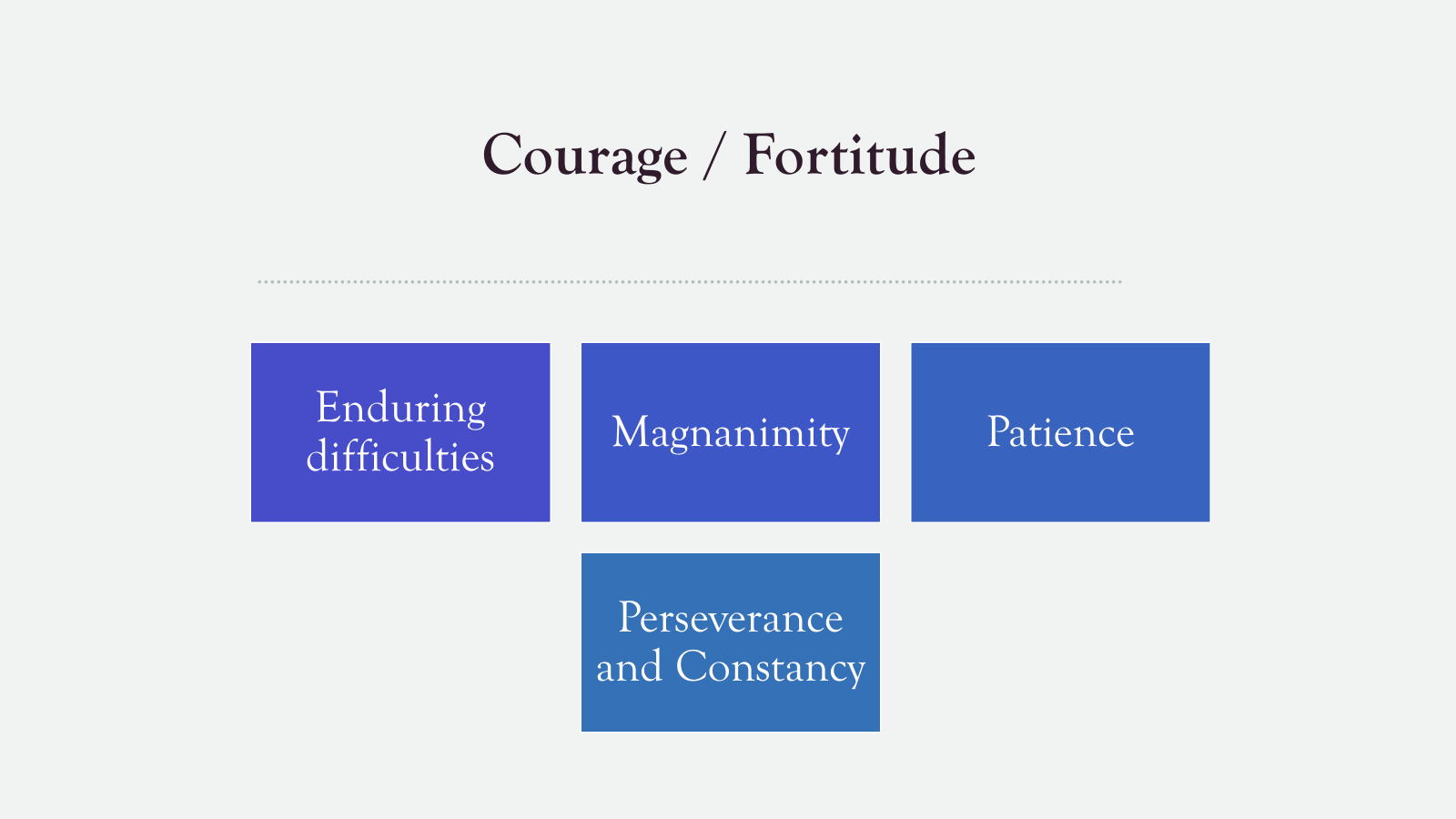
Then we have the cardinal virtue of fortitude or courage. Its sub-virtues are qualities like:
Enduring difficulties
Magnanimity
Patience
Perseverance and Constancy
In the classical Christian tradition, courage and fortitude are synonymous, but in English courage has come to have a restricted meaning that often blocks our ability to understand this important cardinal virtue. We often think of courage as being brave when we venture into something, when we initiate an attack. It’s like going into battle, or driving in a challenging part of the city, or initiating a difficult conversation. That’s certainly an important aspect of courage. But there is another side of courage that we don’t tend to think about as much in the modern world, but which is probably even more relevant to us. That aspect of courage is enduring difficulties with patience and fortitude.
Imagine maintaining inner calm in the midst of a besieged city. This type of courage is something we can all practice, even if we haven’t been called to go on the offensive and attack. God might call us to exercise patient fortitude in the face of ill health, or when observing the sickness of a loved one, or when experiencing uncertainty about a job. It could be remaining patient and strong in the face of uncertainty about a relationship, theological confusion, or when struggling to discern God’s will about an important life choice. When we face these challenges, the virtue of courage is what enables us to approach the circumstances with patience, resilience, and inner strength.
Again, the range of the English word “courage” doesn’t capture this side of the virtue so well, and that’s why it’s important to always pair courage with fortitude.
We exercise this virtue by not going to pieces when things go wrong. We exercise this virtue by being able to face great obstacles and uncertainties with an inner calm, even joy. Think of Paul and Silas singing hymns at night when imprisoned in Philippi. Would you have enough fortitude and courage to sing praises in prison? What about singing praises during times of confusion, anxiety, or being overwhelmed? What about remaining grateful during sickness, or in life’s trenches?
You can begin to see why patience is a sub-virtue of fortitude/courage. Patience helps us bear sorrow well, not just the sorrow of waiting for something, but any type of sorrow.
Again from Sri:
Patience is the virtue that moderates our sorrow, safeguarding a clear mind in the midst of life’s difficulties. Patience helps us bear sadness in such a way that we do not abandon whatever good we should be doing in our lives. Sri, p. 136
Though in modern use the word “patience” is usually limited to the sorrow of waiting, the virtue of patience itself is about all kinds of sadness; sorrow over a dating relationship that ended, sadness about not getting a job, disappointment over something not turning out well, regret over something you said. Life is full of times when things don’t go the way we hope. We need patience to help moderate these sorrows so that we can continue giving the best of ourselves to the people in our lives and to our daily responsibilities. 138
Justice: The Virtue of Right Relationship
I’m not going to take a deep dive into each of the four cardinal virtues because I want to leave time for talking about the relationship between virtue and emotion. So we’ll go over some of these quickly.
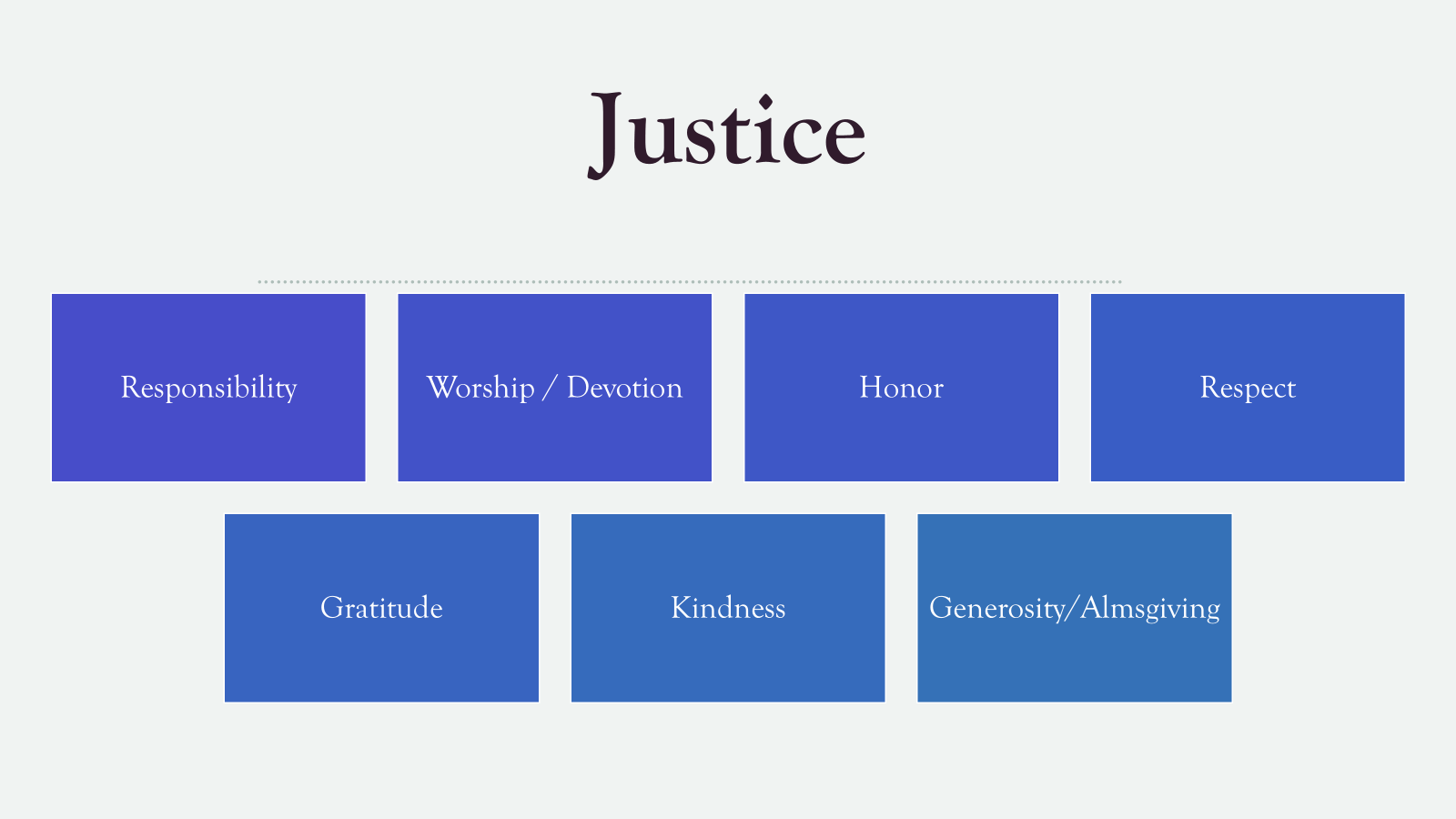
In the classical Christian tradition, justice (like courage) is more broad than we normally conceive. It includes acknowledging and returning the kindness or favors received from others, or as some of the Greeks defined it, “giving to each his due.” It’s about being in appropriate relation to God and man. It includes sub-virtues like,
Responsibility
Worship / Devotion
Honor
Respect
Gratitude
Kindness
Generosity/Almsgiving
I find it interesting that, historically, gratitude has been classified as a sub-virtue of justice. If we think of justice as giving to each his due, then gratitude is what we owe to God for all the undeserved favor. I’m not going to develop that right now because gratitude requires an entire lecture of its own.
Temperance: The Healing of Desire
Another cardinal virtue is temperance.
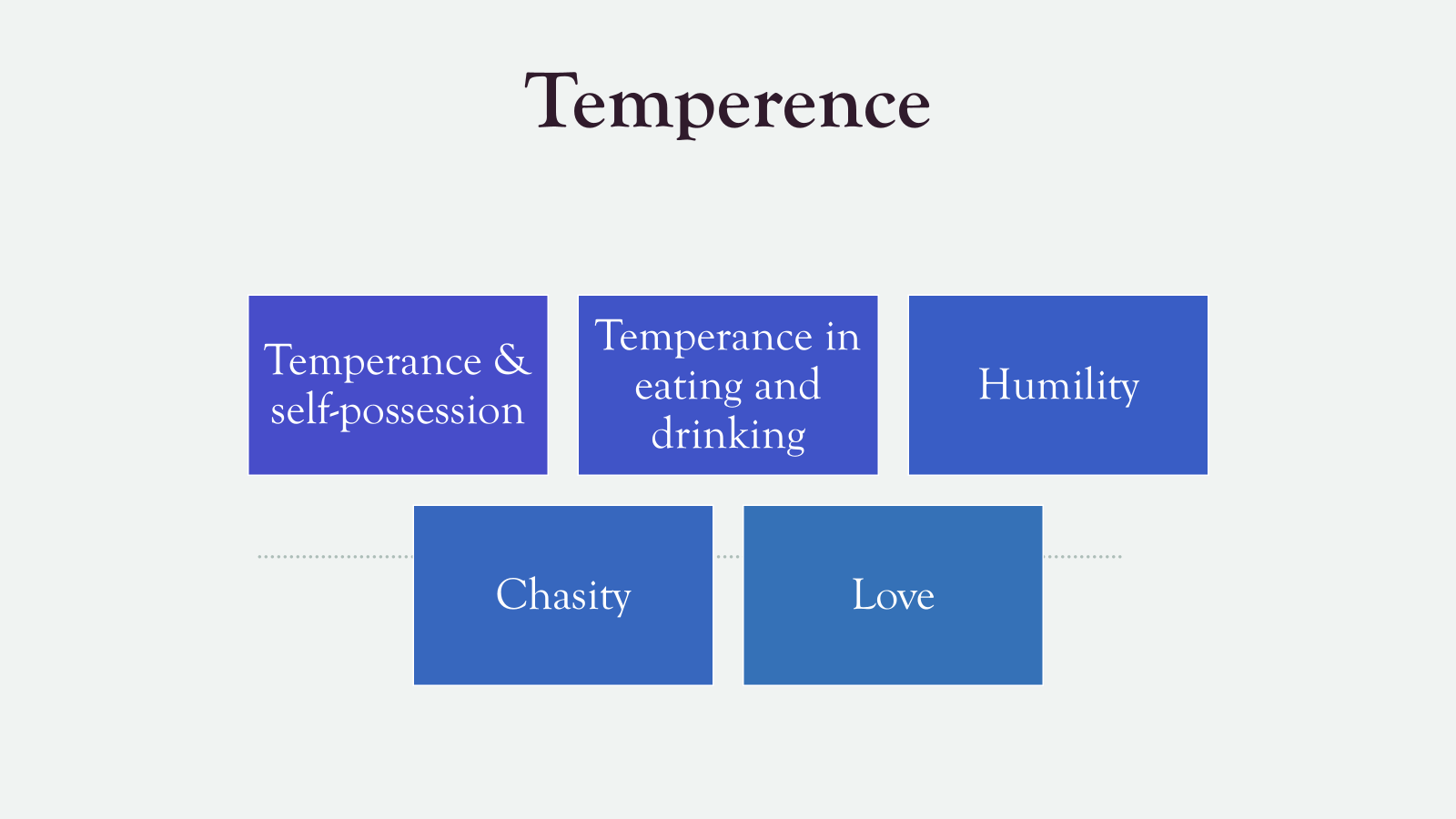
Temperance is not just about abstaining from too much drink, though that’s part of it for sure. But more broadly temperance is about self-possession. It’s ultimately about the healing and transformation of desire so that our affections become rightly ordered toward God. And insofar as temperance is about rightly-ordered affection, it makes sense that it involves sub-virtues like love, though love plays a role in all the virtues. (We’ll talk more about the healing of our affections in the second half of this lecture.)
Theological Virtues: Faith, Hope & Love
Then in addition to the cardinal virtues, there are the theological virtues that help guide the cardinal virtues to spiritual ends. One might excel in all the cardinal virtues, but without faith in Christ, hope in His promises, and love of God, the Cardinal Virtues won’t be spiritual. Thus, the theological virtues are Faith, Hope and Love.
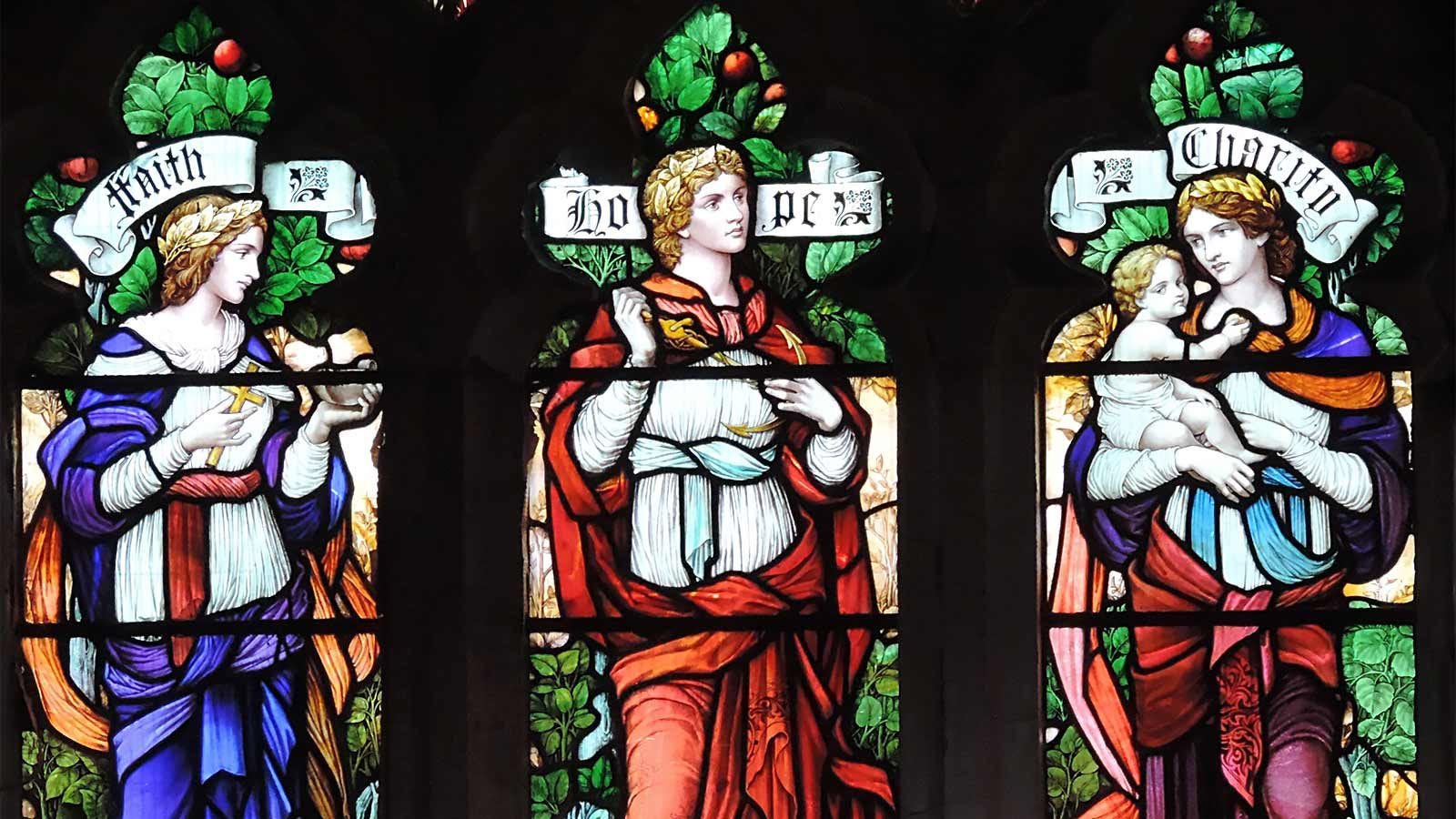
I’m not going to dwell on these theological virtues, nor how they branch out and inform all the other virtues, because I want to spend time discussing spiritual emotions.
Virtue and the Healing of Emotion
We’ve been circling around the idea of emotion already—for example, in talking about the role of desire and affection in the virtuous life. I explained that virtue enables our desires to be reordered to our proper telos so our affections are gradually healed, and oriented toward life rather than death.
Sadly, one of the things that got lost in the shift that occurred around the time of the, so called, Enlightenment (which I dealt with in my earlier lecture), is the role of emotions in the ethical life. Remember that a virtue-based approach to ethics is about the whole human life, not just what someone does. Becoming virtuous requires years of right habits and the formation of character. And a good character includes how someone feels.
Spiritual emotions are involved in virtues such as peace, contrition, joy, patience, love, empathy and, of course, gratitude. These virtues certainly involve more than emotion but not less. For example, you can’t have full contrition without feeling repentant for your sin. You can’t have full and complete patience while you’re feeling frustrated and agitated. You can’t have total forgiveness if you’re feeling bitter and angry. So growing in many virtues involves, at whatever level, the formation of certain types of feeling.
One of the most important spiritual emotions is the joy we derive from holy living. Take Psalm 19:10 which describes God’s judgments as more desirable than gold, and sweeter than honeycomb. Or again, in passages like Psalm 119, we see that the goal is not someone who merely obeys God’s laws, but someone who derives joy from God’s commands—a man or woman whose affections have been honed to delight in the ways of God. Put simply, a saintly person enjoys being holy.
Of course, we have to behave virtuously even when it’s hard, especially when overcoming addiction, resisting sexual temptation, in the early stages of developing good habits, and of course ascetic disciplines. But the more we engage in these types of struggles, the more virtue should become natural and even fun. A saint enjoys being good. That is what Proverbs discusses over and over again, how practicing virtue and growing in wisdom becomes sweet like honey.
As moderns we don’t like to hear that we can train our emotions and affections. We tend to assume that emotions just happen to us like getting a cold, and thus we disconnect emotion from effort, from practices, and we even separate emotion from antecedents in behavior and cognition. The assumption is that if we have to work at feeling a certain way (through behavior and cognitive reframing), or if we have been influenced to feel a certain way by practices and habits, then the resulting feelings are somehow less authentic, less true to ourselves. Consequently, we end up under-appreciating the role of effort and struggle in the formation of spiritual emotions like gratitude, peace, compassion, etc. We assume that dispositions arising after a period of struggle, and after a period of habit-forming behaviors, are somehow artificial and fake. Culture and advertising tell us so many times that we need to just be natural—to just go with the flow of who we are authentically.
Yet if we stop to think about it, we all have a strong intuition that we can train what comes to be authentic and normal for us, and that growing in virtue involves some level of emotion, and that through right habits (including persevering with good habits even when it’s hard) we form the type of character that will enjoy one thing and not another. Sometimes we need concrete examples to demonstrate this strong intuition. Consider this example taken again from Edward Sri’s book The Art of Living. He asks us to consider who is the better husband out of two examples. Is it the man who says to his wife, “Honey, I really wanted to have an affair, but I love you so much that I resisted. Honestly, it was a real struggle, but I made the sacrifice, and I did it for you.” Or is it the husband for whom an affair would be repulsive—who does not even desire to be unfaithful to his wife? Obviously the second, for as Sri comments,
His desires have been ordered well and transformed by God’s grace so that he doesn’t just do the right thing; he desires the right thing and possesses an inner ability that makes it easy for him to resist temptation. (p. 28.)
Being a virtuous person is not simply about doing the right things. It runs much deeper than that. It’s about a person’s disposition, character, emotions, and desires. Do you desire the right things? Do you take delight in the right things?…
God doesn’t want us to have to battle against our desires all the time. He ultimately wants to heal them. He wants to get to the root of our sins by retraining and healing our passions and desires. (pp. 26-28)
What Sri is saying is that the Christian life is not just about battling your desires all the time, as important as it is to be able to resist disordered wants. But ultimately growing in theosis is about our desires being healed so we are attracted to what is good, and being repulsed by what is evil. Ethics is as much about feeling as it is about doing, specifically, it’s about the particular type of feelings in the person who finds goodness attractive and finds sin repulsive.
And then practicing virtue isn’t hard because it’s natural to us—a saintly person wants to be good. This is where we have to rid ourselves of this myth that virtue is more virtuous when it’s hard. Obviously there is merit to ploughing through toward our spiritual goals even when our flesh isn’t cooperating, just like a husband must love his wife even when she’s difficult. And if a husband desires to have an affair, he still shouldn’t do it or else his desires will be even more corrupted than they already are. But the goal in plodding on when it’s hard is to reach a point—whether in this life or the next—where virtue becomes second nature rather than something that always requires huge amounts of willpower. Virtue becomes more or less automatic because it’s attractive and desirable to us.
And as soon as we talk about finding goodness attractive, and delighting in what’s good, we bring in the question of beauty. At some level, we need to perceive the good as beautiful, and to have an emotional attraction to the good because we perceive it as lovely. Here’s how I described this in my 2020 book, Gratitude in Life’s Trenches:
It is easy to react to the idolization of feelings in our culture by…denying the role that both feelings and beauty play within the moral ordering of our lives. This is a mistake, for it is through an emotional attraction to beauty that we are motivated to make moral judgments and to order our lives according to transcendent realities.
Beauty and emotion are closely related in the moral life. Through the sense of beauty, we are moved out of indifference to become emotionally invested in pursuing one outcome rather than another. When Eve succumbed to the temptation to disobey God (Gen. 3:6), it was because the beauty of the tree and its effects (“pleasant to the eyes . . . desirable to make one wise”) captured her imagination with greater force than the beauty of remaining faithful to the will of God. That example might lead us to disparage the role of beauty in moral decision-making, and yet the same principle also works in the other direction as the Holy Spirit sanctifies our feelings, imagination, and aesthetic sensibilities.
Through a sense of Christ’s beauty, we become emotionally invested in following Him. When we observe character traits in Bible characters and saints that are worthy of emulation, when we identify certain conditions as honorable or shameful, when our hearts are stirred in worship by “the beauty of holiness” (Ps. 96:9), or when we order our actions based on a longing for outcomes that lie outside the scope of the present life but are attractive to the imagination—all these powerfully move us because they appeal, at some level, to our emotional dispositions. A rightly ordered sense of beauty is thus central to the moral imagination of the believer.
How do we cultivate right desire? How do we train our affections so we feel that goodness is beautiful? There are a multiplicity of ways: worship, prayer, developing good habits, spending time with virtuous people, using theology to better understand our faith, frequent participation in the Holy Eucharist, and of course through habits that reinforce the virtues so they become second nature to us. I’ve discussed elsewhere how we also train the affections by cultivating the moral imagination through stories that shape what we perceive as noble and good. And in the video below, from a panel last year, I discuss the role that worship plays in training our affections.
Through training our affections in these kind of ways, virtue becomes deeply ingrained in our character, not just something we do, but part of who we are. And this ultimately impacts what we enjoy. We know this is true, not just theologically, but phenomenologically based on what we observe all the time. Consider how the choices a man makes when he is young—from what types of music and stories he allows to form his imagination to decisions about whether to pursue piety vs. the passions—are part of what eventually determines the sort of woman that will attract him, that He will enjoy being around. The enjoyment a man derives from having a relationship with a modest, virtuous woman is organically related to the work of becoming virtuous himself. But just as one who has not worked to appreciate good literature may puzzle why another would prefer Milton over comics, so a man who has not worked to cultivate virtue may find it hard to understand why another would enjoy having a relationship with a modest, virtuous woman.
The sobering reality is that in all the choices you make, day in and day out (including everything you allow to enter your mind and imagination), gradually determines what you find attractive, and what you enjoy. The things we enjoy can evolve based on the choices we make and the stimuli we expose ourselves to. What we consider beautiful, what we are attracted to, is often downstream from struggle and habit-forming behaviors. This is even true of non-ethical matters. If you think of the joy a wine connoisseur or an art critic feels in the presence of a particularly special specimen of their craft, we know that those feelings have been honed by years of training, hard work, and struggle.
Every choice you make is training your heart to find something beautiful. If you give your senses a diet of images from the mall and Instagram, that will train your heart differently than a diet of classical music, good literature, and worship.
From Habit to Freedom
So we can summarize some of the ground so far in the second half of this lecture:
Over many years of right behavior and obedience to God’s commands, we come to have good habits.
Over time, good habits lead to character traits (virtues).
Good character traits (virtues) result in us loving God’s commands.
Loving God’s commands is correlated to rightly-ordered emotions (including spiritual feelings, attitudes, and properly aligned dispositions).
This results in true freedom.
The problem with legalism is that it stops at #1 and thinks that’s enough. So the legalist who wants to progress further in the faith simply adds more dos and don’ts, becoming overscrupulous and finding more things to be fussy about. Legalists don’t understand that God actually calls us to a higher standard, namely, to move from the first step to the later stages where God’s commands are sweet to us and where our affections are sanctified (without, of course, leaving behind the earlier stages, which is the whole point of habituation).
The sinister side of this is that because of sin, this whole process can also work in reverse. Through wrong behavior and disobedience to God’s commands, we can reach a point where we do not find God’s ways beautiful, but we actually come to delight in things that misfit our nature. In our society the disordering of affection is often packaged as true freedom even though it is ultimate bondage.
Becoming the People We Were Created to Be
So perhaps we can now return to the questions with which we began: “what kind of person should I become?” And “what does a flourishing human life look like?”
The answer is not simply to become someone who follows the rules. The goal is to become the kind of person whose whole life, including his emotional dispositions, has been ordered toward the Good—someone whose judgment, desires, feelings, habits, relationships, and actions are gradually being brought into harmony with God.
This is what the virtues are for. Prudence teaches us to see and judge reality rightly. Justice teaches us to give God and our neighbors what is due to them. Fortitude gives us the strength to remain faithful when life becomes difficult. Temperance teaches us to possess ourselves rather than be possessed by our passions. And the theological virtues of faith, hope, and love lift all of these virtues beyond mere human excellences and orient them toward God Himself. Through all these virtues, the Holy Spirit is gradually changing the kind of person we are. Through repeated actions, our habits are formed; through our habits, our character is formed; through our character, our desires and emotions are gradually healed; and as our desires become rightly ordered, we begin to find the good beautiful and to delight in what once required an act of sheer willpower.
We cannot achieve any of this on our own, as if virtues are simply another form of self-improvement. Remember that when the baby turtles were lured away from their true desire to the artificial lights of the city, they had to be picked up and refocused to their true destination. That is like what Jesus did for us through his death and resurrection: he picked us up and carried us to our true homeland. Then He gave us His Spirit to enable us to practice the virtues that counteract the passions that would lure us away from our true heart’s desire, namely God Himself.
Further Resources