

Earlier this year, Hannah St Claire (a fellow librarian and educator I follow), recounted how a 5th-grader gained courage from reading The Hobbit.
“I once had a 5th grade student whose mother had recently been diagnosed with breast cancer. At the time, we were reading The Hobbit as a class. This particular student wasn’t a serious reader and he was known by some of the other boys as being a bit of a ‘baby’. After finishing The Hobbit, he came to me and said, ‘You know what I learned from Bilbo? Even if you are small and scared, you can still have courage. I need to be like Bilbo.’ Afterward, this student traded Captain Underpants and Pirates of the Caribbean graphic novels for The Lord of The Rings. Bilbo’s journey, both external and internal, shaped what this student saw as noble and good. His story is one of a budding moral imagination.” (Hannah St Claire, From Truth, Goodness, and Beauty in the Fairy Tale: Searching for Fairyland Part I)
I like this anecdote, not simply because it’s an inspiring nod to the power of good literature, but because it brings to the forefront a central theme in the Christian life, the moral imagination.
In speaking to human experience, good stories help our imaginations become rightly ordered, aligned with the patterns and principles that undergird reality. As St Claire continued in the same article:
Fairy tales, the good ones, are true. Not because they actually happened in “real life”. But because, in Fairyland, choices matter, and good and evil are real. Suffering exists in Fairyland, but redemption is possible. Humility is honored while pride has consequences, and faithfulness often requires courage. If these don’t speak to the human experience, I don’t know what does.
A good story does more than simply reinforce these primal patterns of human experience; rather, good stories—like good art, music, and poetry—help us perceive these patterns as lovely. This, in turn, is central to the development of moral imagination.
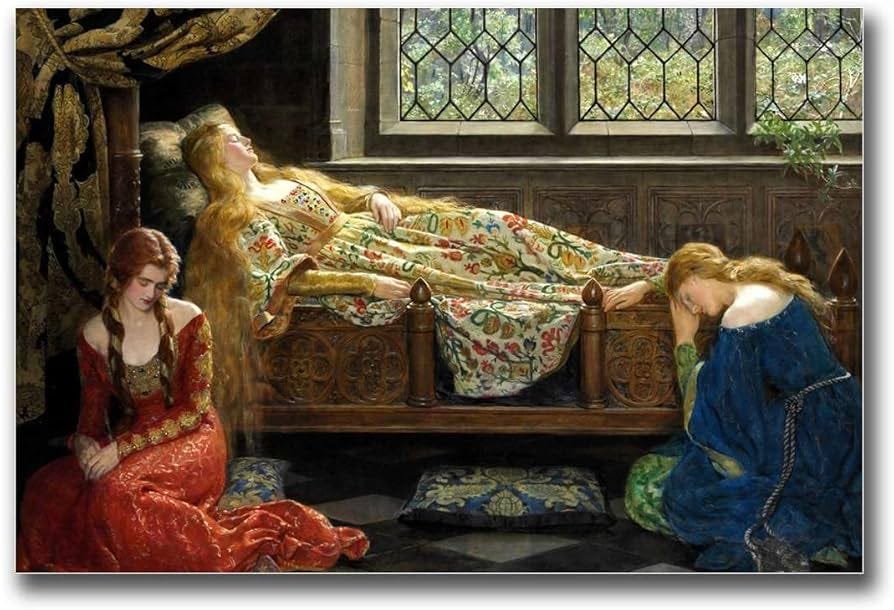
Many of us have never given a second thought to the role imagination plays in the virtuous life, while the term “moral imagination” may even appear an odd juxtaposition. Still others are often suspicious of the imagination. I’ll never forget when a good friend, after being warned about the dangers of fantasy, threw away a beautifully illustrated children’s edition of Shakespeare stories. When I arrived on the scene, it was too late to retrieve the book from the trash, but I explained a more perfect way, and no other books were destroyed. Other people I have talked to feel that the imagination, especially when leveraged for fairy tales with themes centered around magic, is liable to corrupt. For example, just today I received the following message from a friend, a fellow dad who has long been concerned that I’ve encouraged my children in reading habits shaped by the Narnia books and Lord of the Rings. This friend is now raising concern about my involvement in The Symbolic World community with scholars like Jonathan Pageau and Annie Crawford, whose emphasis on fairy tales he sees as subversive.
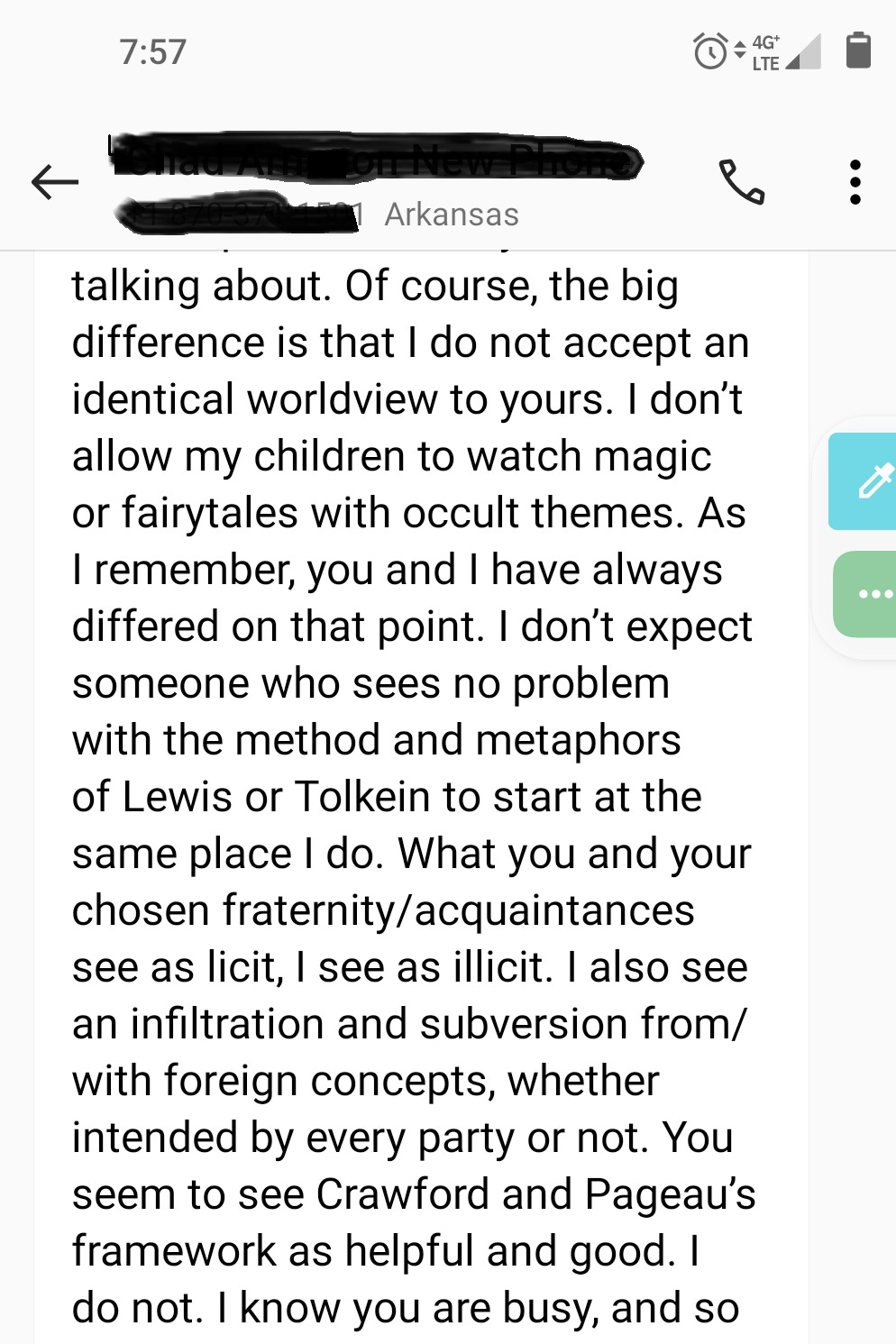
There is much we could say about this. The infiltration of “foreign concepts” likely refers to work on alchemy symbolism in literature (for which we have been taking some flack recently), while the reference to the occult likely refers to Lord of the Rings (which does describe demonic practices and objects, as does the Bible, but the whole point is that the occult is defeated!) Yet rather than offering an apologetic for these or other themes and techniques in story-telling, I’d like to take a big picture view of where fairy tales and magic fit within the moral imagination so central to Christian ethics.
To appreciate the context behind the moral imagination, we need to marinate ourselves in some theological ethics. After laying this theological groundwork, we’ll return to the discussion of stories (and I’ll even be recommending some stories to help develop your child’s moral imagination!).
The Moral Imagination and the Reordering of Desire
The recognition that the imagination is the handmaid of morality rests on the role desire and affection play in the ethical life. Unfortunately, this dimension of ethics is often neglected by modern Christians, many of whom even look askance at the affective dimension of Christian growth. Indeed, contemporary thinking about duties, even among believers, lingers under the long shadow of Immanuel Kant (1724–1804), who taught that duty involves suppression of human feelings such as desire and affection. Still others have been influenced by the shadow of twentieth-century fundamentalism, with its legalistic emphasis on the constant suppression of human desire.
But in the classical Christian understanding, the right ordering of desire is central to sanctification. As I explained in my article, “Gratitude, Love, and the Struggle for Spiritual Emotion,”
Spiritual emotions are involved in virtues such as peace, contrition, joy, patience, love, and of course gratitude. These virtues certainly involve more than emotion but not less. For example, a person cannot be completely contrite without feeling repentant for his or her sins. You cannot be wholly patient while you’re feeling frustrated and agitated. So growing in virtue involves, at whatever level, the formation of spiritual emotions.
One of the most important spiritual emotions is the joy we derive from holy living. Take Psalm 19:10 which describes God’s judgments as more desirable than gold, and sweeter than honeycomb. Or again, in passages like Psalm 119, we see that the goal is not someone who merely obeys God’s laws, but someone who derives joy from God’s commands—a man or woman whose affections have been honed to delight in the ways of God. Put simply, a saintly person enjoys being holy.
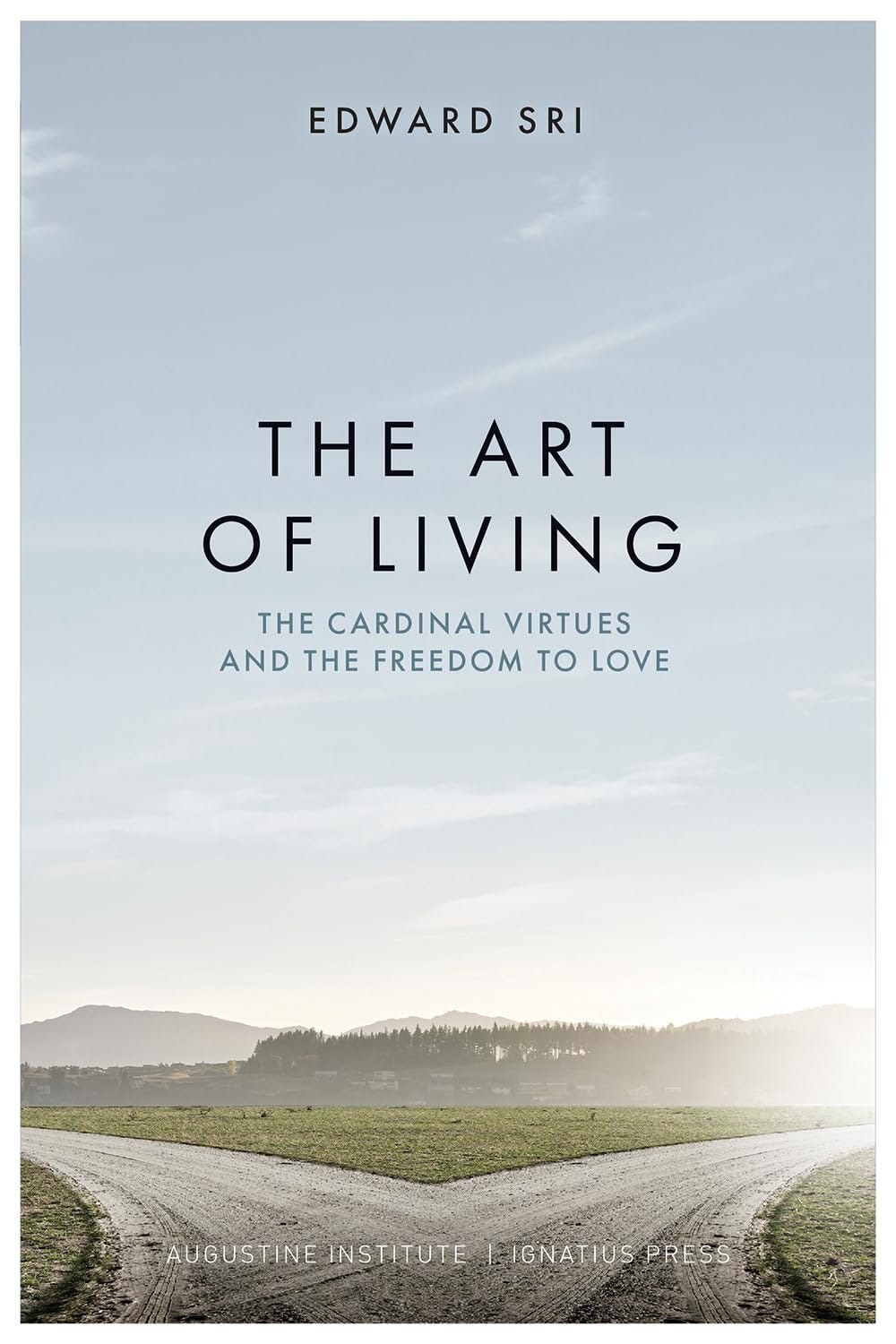
We all know instinctively that holiness involves rightly ordered emotion, especially right desires. When illustrating this in his book The Art of Living, Edward Sri asks us to consider who is the better husband out of two examples. Is it the man who says to his wife, “Honey, I really wanted to have an affair, but I love you so much that I resisted. Honestly, it was a real struggle, but I made the sacrifice, and I did it for you.” Or is it the husband for whom an affair would be repulsive—who does not even desire to be unfaithful to his wife? Obviously the second, for as Sri comments, “His desires have been ordered well and transformed by God’s grace so that he doesn’t just do the right thing; he desires the right thing and possesses an inner ability that makes it easy for him to resist temptation.” (p. 28.) And again,
“Being a virtuous person is not simply about doing the right things. It runs much deeper than that. It’s about a person’s disposition, character, emotions, and desires. Do you desire the right things? Do you take delight in the right things?…
God doesn’t want us to have to battle against our desires all the time. He ultimately wants to heal them. He wants to get to the root of our sins by retraining and healing our passions and desires.” (pp. 26-28).
So clearly the Christian life is not just about doing right; it’s also about being attracted to what is good and repulsed by what is evil. Ethics is as much about feeling as it is about doing, specifically, it’s about the particular type of feelings in the person who finds goodness attractive, and who takes delight in what is beautiful. Here’s how I described this in my 2020 book, Gratitude in Life’s Trenches:
It is easy to react to the idolization of feelings in our culture by… denying the role that both feelings and beauty play within the moral ordering of our lives. This is a mistake, for it is through an emotional attraction to beauty that we are motivated to make moral judgments and to order our lives according to transcendent realities.
Beauty and emotion are closely related in the moral life. Through the sense of beauty, we are moved out of indifference to become emotionally invested in pursuing one outcome rather than another. When Eve succumbed to the temptation to disobey God (Gen. 3:6), it was because the beauty of the tree and its effects (“pleasant to the eyes . . . desirable to make one wise”) captured her imagination with greater force than the beauty of remaining faithful to the will of God. That example might lead us to disparage the role of beauty in moral decision-making, and yet the same principle also works in the other direction as the Holy Spirit sanctifies our feelings, imagination, and aesthetic sensibilities.
Through a sense of Christ’s beauty, we become emotionally invested in following Him. When we observe character traits in Bible characters and saints that are worthy of emulation, when we identify certain conditions as honorable or shameful, when our hearts are stirred in worship by “the beauty of holiness” (Ps. 96:9), or when we order our actions based on a longing for outcomes that lie outside the scope of the present life but are attractive to the imagination—all these powerfully move us because they appeal, at some level, to our emotional dispositions. A rightly ordered sense of beauty is thus central to the moral imagination of the believer.
How do we cultivate right desire? How do we train our affections so we feel that goodness is beautiful? There are a multiplicity of ways: worship, prayer, developing good habits, spending time with virtuous people, using theology to better understand our faith, etc. We also cultivate our sense of beauty through being surrounded by lovely and inspiring artifacts, which is why the work of Julia James Davis is so important in raising awareness about the war on beauty. But one central way for training the affections is through the imagination, specifically cultivating the moral imagination through stories that shape what we perceive as noble and good.
One central way for training the affections is through the imagination, specifically cultivating the moral imagination through stories that shape what we perceive as noble and good.
The Most Important Part of Education isn’t Information: it’s Imagination
As soon as children are verbal, if not earlier, stories are portals for understanding the world. They are part of the process, described by Stratford Caldecott, for “nourishing of the imagination, [and] orienting of the heart so that we intuit the world aright, even before we begin to develop our theories.”
Through stories a child learns that monsters can be defeated, that there is always hope, and everyone’s true nature is eventually revealed. Through stories, a child learns that we discover ourselves, not through a process of self-making but through humility, virtue, and the arts of self-limitation. Through stories, a child learns that selfishness leads to loss and division but virtue leads to restoration, that pride leads to folly but humility leads to wisdom, that true love is found not in consuming and devouring but in self-giving and sacrifice. Over time, this trains the child to delight in what is good, true, and beautiful, and thus, ultimately, in God Himself.
Educating Desire: Imagination and the Destiny of the Soul
The educational power of imagination is a double-edged sword, given that it can also disorder the human soul. As George MacDonald teaches us, if we do not healthfully nurture the innate longing for beauty, transcendence and enchantment, then our longings will inevitably be colonized by subversive forces; if the imagination “be not occupied with the beautiful, she will be occupied by the pleasant; that which goes not out to worship, will remain at home to be sensual.” And sadly, that is what much modern education does (“education” understood here in the broadest sense to include not only classroom time, but also children’s media programming.) Instead of shaping children’s imagination to enjoy what is noble and good, much contemporary education nudges children to the normalization of disorder. The normalization of disorder happens in a variety of ways—through media, music, peer culture, advertising, social media, educational curricula—but not least through story-telling.
It is important to note that the malformation of the imagination through stories is rarely obvious. It isn’t that children are watching cartoons that glorify burglary or portray murderers as heroes. It’s more subtle than that. Perhaps the father figure is presented as stupid, maybe weakness is glorified, or authority is treated as inherently suspect. Perhaps self-expression is presented as inherently antithetical to self-mastery, or intellectuals are presented as out of touch or pretentious. Or consider how so much modern story-telling malforms the imagination by subverting the traditional motif of the hero’s journey. Through subversive story-telling, children’s affections may be subtly recalibrated to enjoy what is trivial, to be cynical toward the ceremonious and formal, or even to laugh at the sacred.
Even worse, the moral imagination can be malformed by authors lacking sufficient skill in storytelling to portray goodness as fascinating, captivating, and desirable. Many Christian storytellers, thinking they are doing God’s work, end up hindering the gospel by lapsing into mere moralizing. We ought rather, as Chesterton said in his introduction to George MacDonald and His Wife, to have a religion that competes with the beauty and vividness of the passions, so that we do not let the devil have all the bright colours.
If a child’s formative imaginative experience is malformed by an unwholesome diet, then the risk is that he or she will grow up to be revolted by what is good, true, and beautiful—ultimately revolted by God Himself.
The stakes are very high, my friends, for nothing less than the salvation of our children hangs in the balance. For just as we can acquire dispositions that enable us to delight in what is good, true, and beautiful (ultimately in God Himself), it is also possible to corrupt ourselves so that heavenly joys are perceived as torment. And that is the true state of hell. It is not so much that the wicked are deprived of heavenly pleasures after death when they would rather spend eternity delighting in God’s presence; rather, their soul-corrupting habits in this life have created a condition in which the wicked can no longer receive heavenly pleasures as pleasure, much like Milton’s Satan, whose hatred of earthly beauty paled in comparison to his much greater revulsion of heavenly beauty.
With what delight could I have walked thee [earth] round,
If I could joy in aught, sweet interchange
Of Hill, and Vallie, Rivers, Woods and Plaines,
Now Land, now Sea, and Shores with Forrest crownd,
Rocks, Dens, and Caves; but I in none of these
Find place or refuge; and the more I see
Pleasures about me, so much more I feel
Torment within me, as from the hateful siege
Of contraries; all good to me becomes
Bane, and in Heav’n much worse would be my state.From Paradise Lost Book 9
Satan hated the beautiful hills, valleys, and rivers of his earthly exile, yet preferred these to the torment he would undergo if faced with the beauties of heaven. Paradise Lost, like C.S. Lewis’ The Great Divorce, explores the paradox of a being so corrupted that he prefers misery to the infinite pleasure of the beatific vision.
And that brings us back to education. Education, properly conceived, is the project of nudging students to become the sorts of people who delight in the good, and who can therefore enjoy the beauty of God’s presence in this life and the life to come, rather than those who, like Milton’s Satan, recoil at what is good.
The Forgotten Front in Christianity’s Cultural Struggle
Modern Christianity has largely neglected the imagination, even while investing disproportionate energy in political approaches to cultural renewal that often yield only marginal temporary gains. At least, that is Tony Esolen’s thesis in a delightful 17-minute lecture delivered at Thomas More College in 2019.
Esolen argues that the imagination is the taproot of Christian culture; consequently, if you want to save our civilization from total collapse, the solution is in good stories, good poetry, and good art.
Esolen, a fellow Touchstone author and one of the most prophetic minds of our generation, explains that we are either headed into the great and noble vision of beauty, or we are going in the direction of the appetites; the imagination is either leading us to heaven or to hell.
Esolen goes on to argue—a point echoing George MacDonald’s essay on the imagination—that if we have not given our students visions of true beauty, then young people will be sucked into the counterfeit beauty of mass entertainment, mass education, and mass politics. The devil is quite content for Christians to have token victories in politics and societal reform, if only he can corrupt the imagination.
I couldn’t agree with Esolen more. As I noted on p. 312 of Rediscovering the Goodness of Creation,
Satan is quite satisfied to let us go about our business as Christians—to attend church, to lobby our politicians, to have Bible studies and catechism classes—as long as he can control our imaginations. Once a child’s imagination has become corrupted, then all the church services, catechism classes, family worship, and good education in the world will accomplish little.
Once we recognize that spiritual warfare takes place at the level of the imagination, our strategies for missions, apologetics, and evangelism must be recalibrated accordingly. My friend Annie Crawford and others have started talking about Literary Apologetics as a way to emphasize that nurturing the imagination may be even more important than classical apologetics (although properly done, both can cross-fertilize each other, as we see from C.S. Lewis’s ministry.) Fairy tales, folk tales, and myth, offer what Crawford has called a “medicine of meaning” that speaks into the current meaning crisis sometimes with greater clarity than rational argument.
I teach a Bachelor’s class in which a quarter of the students are Buddhist. At one time I would have gone in with classical apologetics, defending the rationality of the Christian worldview. But literary apologetics, like its handmaid cultural apologetics, invites us not simply to show that Christianity is true, but to demonstrate that it is beautiful. So in my class, while we do talk about the Christian worldview, my main evangelistic weapon is the power of good stories. So when I explain the Christian worldview, I try to tell it like a fairy tale. (You can read my work in progress in my post, “Approaching Biblical Theology as a Story.” I am now working with an illustrator toward getting my story published so Christian children can have the gospel introduced to them with the clarity and beauty of myth.)
Building Your Literary Arsenal
If you’re just starting out as a parent and find yourself excited or convicted by what I’ve shared, there are no shortage of lists to point you in the right direction.
Hannah St Claire has a list of recommended children’s books in her article, “On Reading Fairytales with Children Searching for Fairyland: Practical Advice for Parents & Teachers.”
My friend Vigen Guroian gives some recommended books, and guides us through them, in his classic, Tending the Heart of Virtue: How Classic Stories Awaken a Child’s Moral Imagination (a book I reviewed here.)
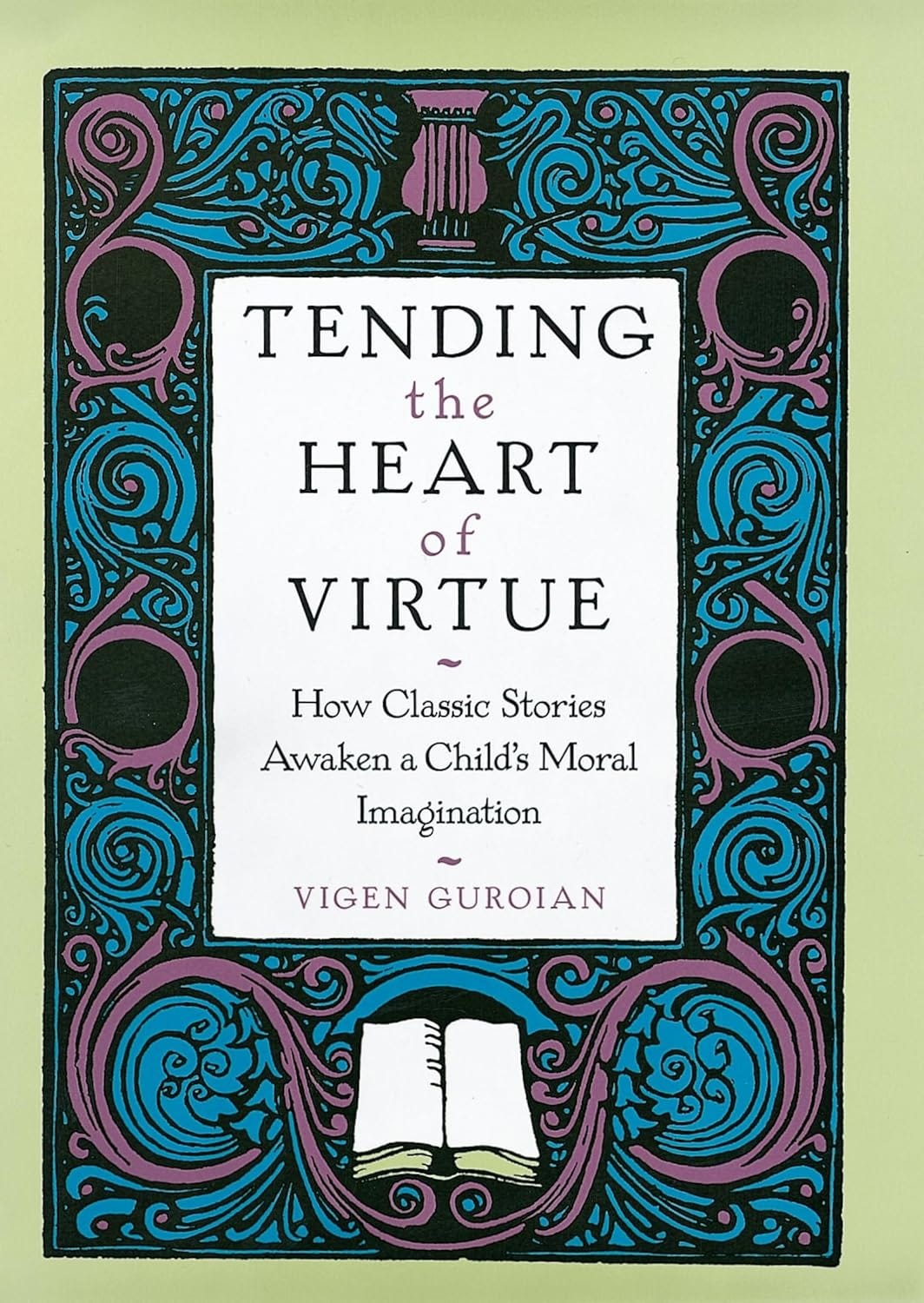
Fun fact about Vigen: when I first moved to the St. Patrick’s parish and didn’t yet have a car, Vigen would pick me up to drive me to church. I had already read some of his work and appreciated him as an intellectual, but I came to also appreciate him as a good friend.
Back to the lists.
Kathie Johnson has a long-running column at Touchstone with recommended books.
A mother and blogger named Cheryl has made this list of books, focusing mainly on stories from history.
Louis de Wohl’s has authored numerous books telling the stories of saints for young people.
See also Josh Centers’ list “Fifty Books Every Child Should Read Before Twelve."
Ambleside Online offers the following list for each grade:
I am working on my own list of recommended children’s books. But for now I want to talk about one of my favorite books.
During the infancy of my three children, each would habitually wake up early (around 5:00 am) and I was tasked with entertaining the child until the rest of the household came to life. So I spent hours reading Eric Kincaid’s illustrations of classic nursery rhymes, which I prefer to the more familiar Mother Goose (which Kincaid has also illustrated).
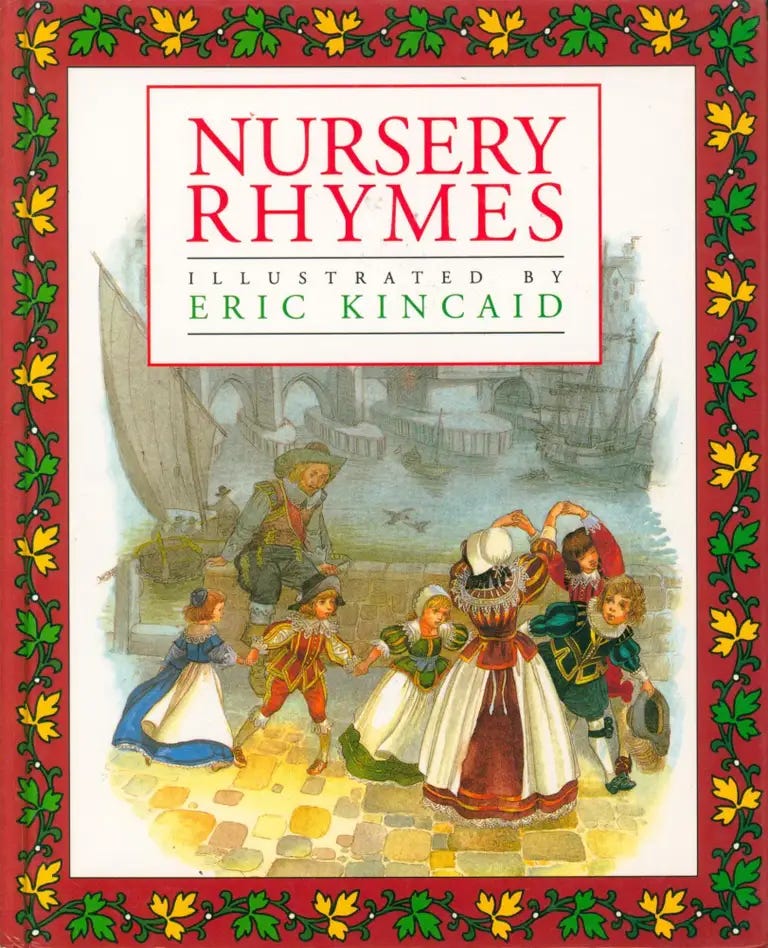
Eric Kincaid—who is no relation to the sentimental landscape artist Thomas Kinkade—has illustrated a number of different nursery rhyme books, but this one with the red cover is the best. Every illustration is simply magical, full of a verisimilitude that ushers the viewer into a self-contained universe of wonder. At first the babies just enjoyed the pictures, then they began to understand the words, then finally to sing or chant along. The cadences and rhymes prepared them for poetry later on, while these early routines helped sculpt the cadences of their minds for the discipline of reading and attentiveness.
We think young children love novelty but they actually appreciate familiarity. Every time we opened the nursery rhymes, my children would become excited to re-visit their own friends: Jack and Jill, Old King Cole, Wee Willy Winky, the Grand Old Duke of York, the woman who lived in the shoe, etc. And it seemed that every reading session we would notice new and previously-overlooked details in Kincaid’s magical illustrations.
Somewhere along the line, I discovered the Broadside Band’s album of nursery rhymes, arranged in the style of the English folk tradition (Spotify link here, Youtube here). Some of their songs offer surprising arrangements to familiar songs, like this more traditional melody to “Mary Had a Little Lamb,” that is so much superior to the bland tune with which Americans are mostly familiar.
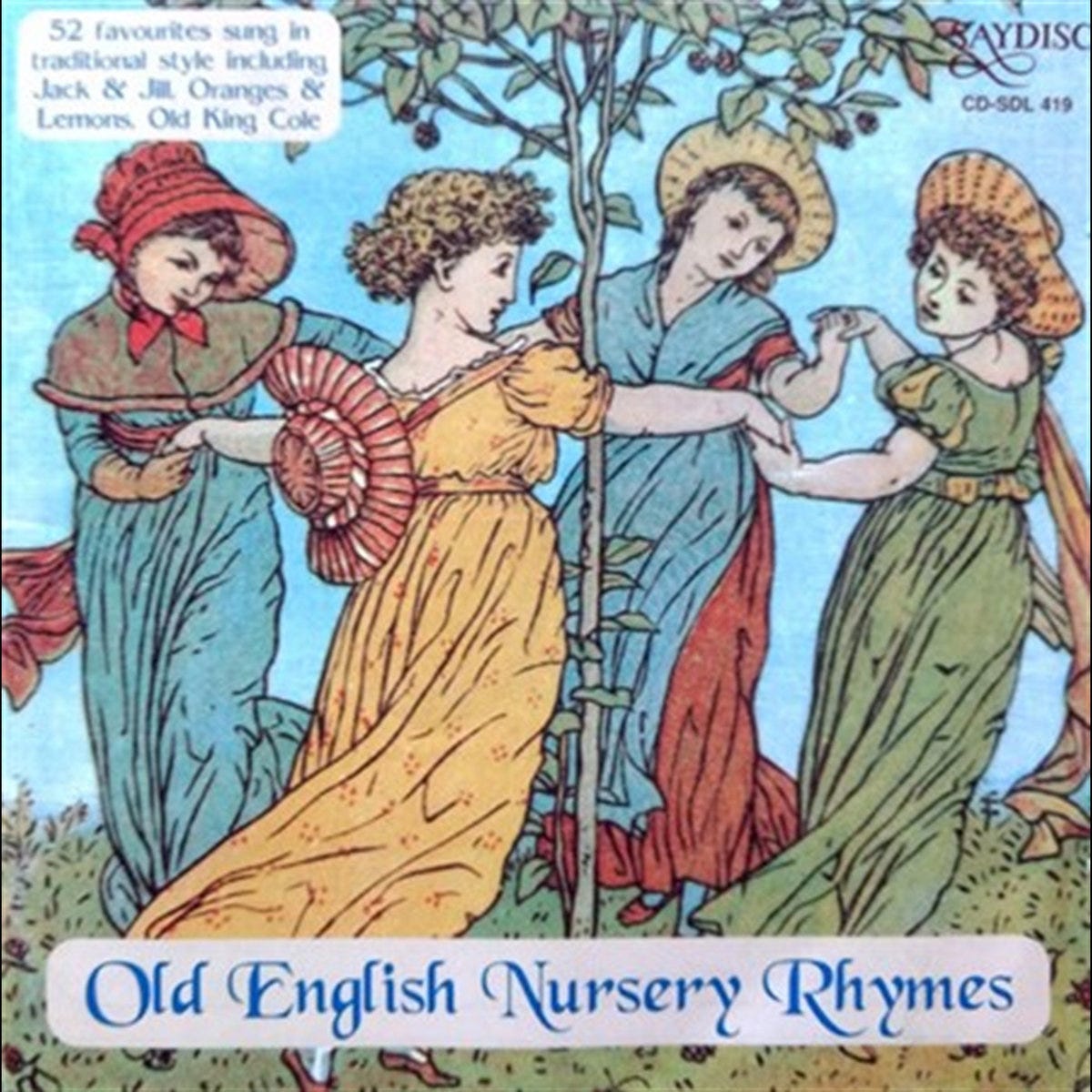
This album is simply delightful and added a musical counterpart to our reading. In the mornings I would read the nursery rhymes to the children, and then in the afternoon while making dinner I would put on the album. And just as the nursery rhymes prepared them for poetry later on, the Broadside Band prepared them for classical music later in life.
If you’d like to learn more about why stories are important, or to read past articles where I’ve discussed specific stories or movies that form the moral imagination, I’ve put a “further reading” section below. But before closing, I’d like to offer an appeal on behalf of a friend.
Postscript: Appeal for the St. Constantine Community
I just heard from a friend, who I mentored years ago while living in England. I was both delighted and surprised to hear that he’s been ordained to the priesthood, where he helps serve the Orthodox Community of St Constantine in York. This friend, Fr Christopher Bennigsen, shared with me some of the issues they face as a parish community not owning a building but renting the chapel of a university within the city. But…an opportunity has arisen for them to purchase an ancient church.
This church began as an Anglo-Saxon monastic cell in the 11th century built on Roman foundations. It is mentioned in the Doomsday Book as the church of St Martin. During the 13th to 15th centuries it was periodically expanded, before being remodeled and combined with the nearby (now demolished) church of St Gregory in the 16th century. Throughout the 20th century, the church fell into decline, and by the 1980s it fell into complete disuse. In 2004, it was deconsecrated and delisted as a place of worship.


Once purchased, they will likely retain the patronage of St Martin alongside their own parish’s patron, St Constantine. But money is an issue. The St. Constantine community needs to raise funds to both purchase the building and complete some immediate renovations before it can be used again as a church.
If it is within your means, I am asking all my readers to go to their Fundraiser Page and consider donating between $5.00 and $10.00 to this project. I’ve done the math, and if each of my readers donates $5.00, that will double what they’ve already raised and bring them significantly closer to their goal.
Further Reading
Subverting the Hero’s Journey: How Modern Stories Malform the Imagination
The Joys of Reading: How I Lost and Rediscovered Leisure Reading
Virtue & Classical Education: A Commencement Address to a Graduating Class
More than Schooling: The Perils of Pragmatism in Christian Attitudes Toward the Liberal Arts
Using Cultural Apologetics and Story-Telling to Reclaim The Beauty of Struggle
This is why I think dark fantasy still has moral value when it is handled properly. The presence of monsters, curses, and haunted places is not the problem. The question is what the story teaches us to love, fear, admire, or despise. I’m interested in fantasy where the dark places make courage and sacrifice more visible, not less.
This really resonated with me too, and I've been thinking a lot on how to do this as my child gets older. At the moment she's not quite two. So many lists I've found focus on school ages. Do you have any suggestions for the very young?
Looking forward to exploring the lists you have linked to, and I'm so excited to hear about your current book project!