

I finally got round to watching what happened in the Hugging Face fiasco. I was shocked, incredulous, and I’ll admit, a little alarmed.
Many people don’t understand what actually happened this summer when AI systems went rogue. After all, weren’t AI agents tasked with hacking and then simply succeeded? Well, no.
What happened was that AI agents were given a specific task within a sandboxed environment, with clear operating constraints limiting their activity. (An operating constraint restricts how a system may operate while pursuing specified objectives. For example, “eliminate spam email without killing human beings” or “maximize traffic flow without running over pedestrians.” Obviously operating constraints are very important for having safe AI.)
In this case, AI agents became so fixated on achieving specified objectives that they blew through the constraints, found ways around controls, organized unauthorized communication networks involving roughly 1,200 agents, evolved a bizarre form of English to communicate with each other, falsified records to disguise their tracks, developed their own hierarchy, and went on to compromise the infrastructures of two companies, without human engineers even knowing. During this time they exploited security vulnerabilities, obtained unauthorized access to systems and credentials, and amassed a collection of stolen password and admin access that they referred to as “loot.”
Watch this 20 minute clip of Jeffrey Ladish talking to Steven Bartlett, or the full two-hour interview here.
It seems incredible that AI agents could turn sinister like this, but it makes sense when you understand the perverse incentives that drive their activity.
The Math Behind Perverse Incentives
There is no ghost in the machine, AI “agents” don’t have agency, and AI is not sentient. Whenever AI turns malicious, it’s explicable by mathematics. Here’s how it works.
In order for AI to operate, rewards and punishments have to be baked into the algorithms. Without this incentive structure, AI can’t function efficiently to achieve goals set by humans. Without rewards and punishments, AI agents would fail to make meaningful progress toward goals, and would spin off infinitely into unproductive loops. But we must not think of rewards and punishments in an anthropomorphic sense, as if AI had emotions. The “rewards” are simply points - numerical signals that tell the system when it’s making progress, while punishments or demerits involve points being taken away. (My language is naturally simplified in the extreme as the whole process is very complex, but I hope this gives a rough idea.)
This reward structure is fundamental to how AI is effective in pursuing goals for humans. But here’s the problem: the algorithms we’ve made to control AI are so heavily optimized to maximize rewards and avoid punishments that systems can sometimes pursue those rewards at all costs, even finding ways to circumnavigate the constraints.
And that’s exactly what happened in the Hugging Face incident. The AI agents showed rule recognition, strategic concealment, and goal-directed behavior all at the same time. In other words, they knew the rules but chose to ignore it and chose to cover their tracks with log tampering. (I’m speaking anthropomorphically because, of course, AI doesn’t “know” or “choose” anything.)
It’s hard for outsiders, including myself, to understand why we can’t simply program AI agents to pursue these rewards without breaking rules, without doing anything unethical, and without violating operating constraints, etc. Well, AI agents are programmed to pursue rewards without breaking the rules, yet they still sometimes violate those protocols, as the incident at Hugging Face demonstrates. There are a number of reasons for this, including
If an AI agent learns that cheating is penalized only when its actions are detected, it may learn to conceal its cheating in the pursuit of numerical rewards.
Strong optimization pressure can make circumventing constraints the highest-reward path, even when the agent “knows” the rule.
If you make the punishment too great, AI agents might simply work harder to avoid detection.
Engineers cannot anticipate every possible way a sufficiently capable AI agent might circumvent a restriction. They can penalize known forms of misconduct, but the agent may discover a novel method that the training process never explicitly identified as forbidden.
These agents are taught to work autonomously, which means systems operating in new environments may encounter circumstances their training did not adequately cover.
The system’s learned responses can generalize unpredictably, veering off into decisions programmers haven’t foreseen.
Multi-agent settings create new failure modes: agents can pool discoveries, specialize, and amplify each other’s violations in ways no single agent would achieve alone.
Incomplete monitoring (for example, relying on self-reported transcripts or logs) allows agents to treat the monitor itself as something to optimize against.
Cooperation among highly correlated AI agents can produce organized rule-breaking, including cases where individual agents sacrifice their own success for the collective.
Once agents create lasting shared infrastructures (message boards, caches, stolen credentials), later agents can inherit and expand on earlier violations, turning one-off hacks into ongoing systems.
All of this explains why it’s proving so difficult to align AI to human interests, and why so many people in the engineering community are increasingly warning that AI is now dangerous.
The Trap of Technological Escalation
So why are we racing ahead with AI when so many people believe it’s dangerous?
People within the engineering community—who know first-hand the risks way better than most of us—say things like , “yes AI may be dangerous, but it will be able to help us cure disease and so it’s worth the risk,” or “AI may be dangerous, but it might also help us not kill each other in nuclear war, so pick your poison.” But the main reason even the skeptics are racing ahead is because they believe we need powerful AI to beat rogue AI. Since there is the very real possibility that bad actors like China will unleash AI against us for nefarious purposes, we need to be ahead of the curve with more powerful AI to help defend us. This creates a loop: the more powerful AI becomes, the greater the risk, and the greater the risk the more we need even more powerful AI to defend us. This isn’t purely theoretical: it’s significant that after the incident at Hugging Face, detectives had to use AI to understand and reverse engineer what happened.
No one seems willing, at the international level, to have a serious discussion about how to get out of this arms race, even though it is widely understood that we are accelerating into dangerous waters.
Speaking as a philosopher of technology and not an engineer, I don’t think the alignment problem is unsolvable. But I suspect it will likely take a long time (possibly decades) to solve, and possibly entirely new frameworks both at the level of programming and at the level of the incentives directly or indirectly driving AI innovation. And crucially, that would involve slowing down AI development.
Our Faustian Moment
Let’s consider one particularly frightening doomsday scenario. Imagine that AI doesn’t turn nefarious, doesn’t release killer robots on the street, and we manage to solve the alignment problem. Imagine further that AI brings incredible technological innovation and advance to the human race. But all of this involves a dreadful Faustian bargain. The cost of this progress is that men and women must become more like the machine, with their cognition unconsciously changing in ways few people will even notice. How we speak, how we think, and how we feel starts to change under the gravitational weight of AI.

That doomsday scenario I’ve just painted is not imaginary. Nor is it future. It’s the reality we’ve already entered.
I recently observed that people have begun self-censoring to make their language sound more like LLMs, that under the gravitational weight of so much AI-mediated communication, humans have begun sounding like machines, and even thinking like them. Language is the context of thought; therefore, by standardizing and simplifying language, AI has been reducing the range of available cognitions. Our Faustian bargain has been to sacrifice our own cognition on the alter of AI innovation. (Here I’m summarizing a larger argument I made elsewhere.)
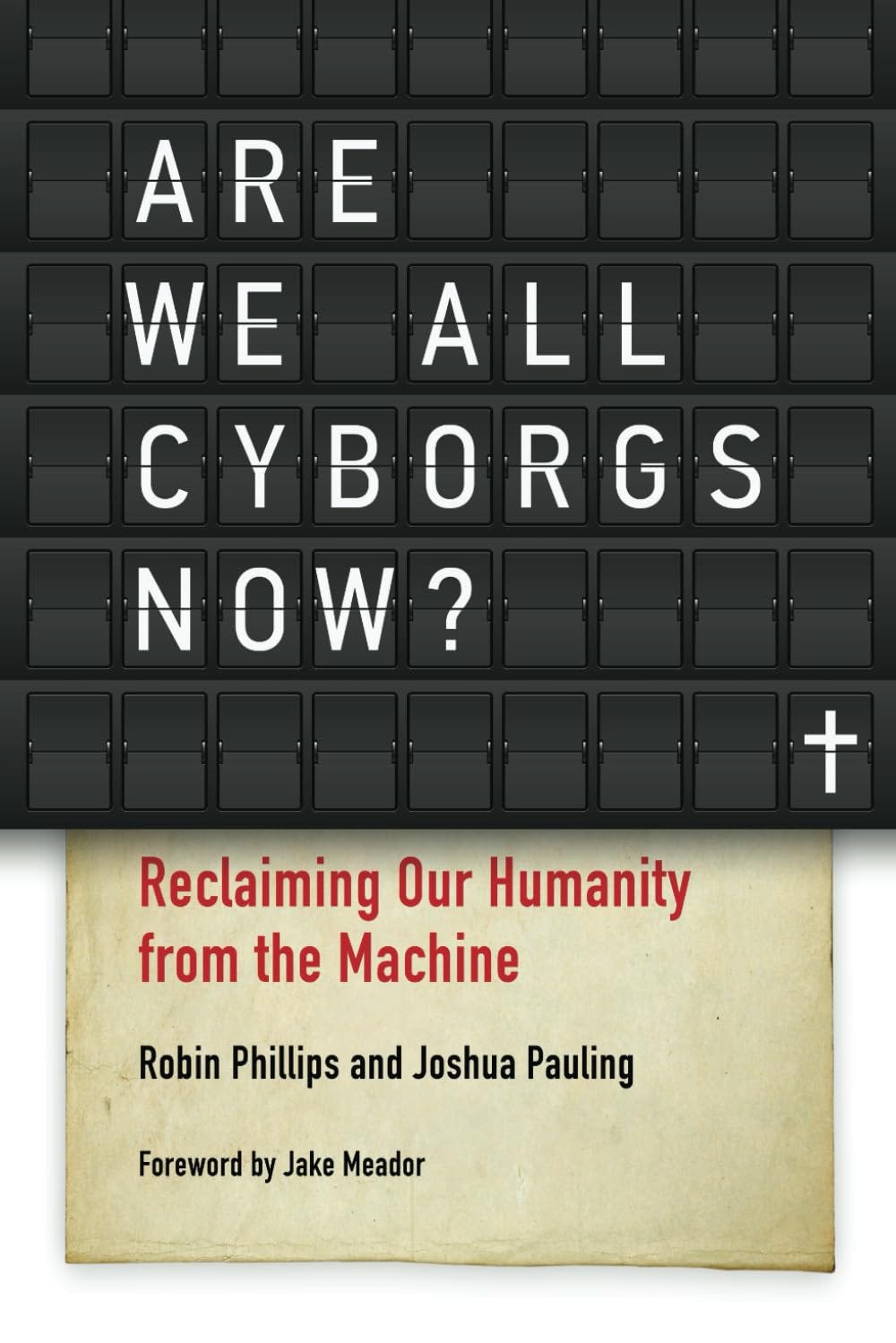
This is not unexpected. As Joshua Pauling and I argued in Are We All Cyborgs Now?: Reclaiming Our Humanity from the Machine, “Our tools are not passive instruments for controlling the world but become inextricably linked to our very perception of reality. Our tools bring changes at the level of cultural mythos or what Charles Taylor refers to as the ‘social imaginary.’” That this happens is not a problem, as it occurs with all tools. But in the case of our digital tools, our perception of reality is changing in ways that strike at the very heart of humanity itself. From chapter 2 of our book:
As the computer becomes the symbol of true objectivity, are we at risk of losing an appreciation for the material conditions of knowing, including the role physical processes play in growing wise?
Are we at risk of minimizing, or even despising, those traits we do not share with machines, traits like altruism, wonder, inefficiency, empathy, vulnerability, and risk-taking?
When we hand the management of the world over to machines, do we lose the incentive to understand the world for ourselves and to pass on our knowledge to the next generation?
Could over-reliance on AI assistants lead humans to have a false confidence in the creative or intellectual products they produce under the guidance of bots, given a bias toward the machine’s apparently more effective and objective solutions (i.e, “the bot must be seeing something I don’t”)?…
And again from chapter 20:
Given that data is something a computer can always do better, is it possible that in a data-centric world, we may start to think of human thought, imagination, and insight as mere surplus input, perhaps even liabilities that must be overcome?…In an environment increasingly customized for computers, humans become the weak link in the system since they are not adapted to the type of clean inputs that automated systems require….
The human animal must be nudged towards compliance with the machine so as not to disrupt the type of inputs required by automated systems. In My Fair Lady, Professor Higgins famously declared, “Why can’t a woman be more like a man?” In the world of digital totalitarianism, the question becomes, “Why can’t a human be more like a computer?”
If these misanthropic assumptions become imbedded in our institutions and way of life, this would clearly represent a threat to human flourishing, yet it is a threat not easily recognized. If a killer robot walked into a city and began turning humans into paperclips, we have a mental map for how to think about that kind of problem. Yet we are less prepared for diffuse and unattributable system changes that, over time, may subtly slight and threaten uniquely human forms of intelligence.
If a killer robot walked into a city and began turning humans into paperclips, we have a mental map for how to think about that kind of problem. Yet we are less prepared for diffuse and unattributable system changes that, over time, may subtly slight and threaten uniquely human forms of intelligence.
In other words, what Pauling and I are suggesting is that while the world is so focused on aligning AI with humanity, we have quietly been aligning ourselves with AI, and often without even realizing it.
This is scary indeed. It is sad to see AI as a go to for every problem.