

In both my professional and personal life, I interact daily with a variety of immigrants, people from Korea, Mongolia, Vietnam, Turkey, Uzbekistan, Egypt, The Bahamas, and elsewhere. These immigrants are living in the United States legally, hoping eventually to become citizens. But since ICE agents began cracking down on immigrants earlier this year, life has become hell for these communities, with people afraid to leave their house without papers, some living in constant fear of deportation, others unwilling to go out in public for fear their brown skin will cause them to be targeted as foreign. It is heart-wrenching to see the suffering among so many friends while being impotent to help.
But maybe I can help the situation by simply sharing what’s been going on in my area.
I live in Prince William County Virginia, and recently took a trip to North Idaho. While in the Northwest, I came to realize what massive ignorance there is about the actions of ICE agents. Specifically, I found a huge informational disconnect between what is happening on ground level and what the White House and the conservative media are telling their devotees. While the left-leaning press has been reporting on the myriad human rights violations perpetrated by the Immigration and Customs Enforcement (see this chilling video put out by CBC News), conservatives tend to dismiss these reports as fake news, or else downplay the human rights violations as marginal.
It isn’t hard to understand the skepticism against left-leaning media sources on the immigration issue. In 2019, I puzzled at how Democrats like Pelosi were framing their opposition to border protection in moral rather than prudential terms, and how their association of border enforcement with racism was painting Democrats into a corner where they could not, even in principle, advocate for stricter measures, even Obama-level enforcement measures (see my earlier articles about this here and here). This over-simplified framing of the immigration debate has understandably left many conservatives distrustful of leftist or even mainstream reporting on anything related to the immigration crisis. Moreover, it is possible to follow carefully curated information diets that reinforce ideological prejudices and insulate people (even people who imagine they are well-informed) from what is really happening on ground level. All this can contribute to a massive information disconnect.
But I usually (not always) find that when I have conversations with people and explain what I’ve been witnessing in my communities, people trust me and change their perspective. All to say, maybe one small thing I can do to help in the current crisis is to share with all of you, dear readers, some of what I’ve been encountering.
ICE Agents Are Targeting Legal Immigrants
Here’s the short version: the propaganda the White House wants us to believe is that ICE agents are only deporting illegal immigrants. This simplistic narrative is perpetrated (often by omission of information rather than lies of commission) on the White House website (see here) and on the website for US Immigration and Customs Enforcement (see here). The narrative they want us to believe (and which, sadly, tens of thousands of well-meaning conservatives now take as gospel truth) goes something like this: people are coming over the border illegally, and this includes both “the worst of the worst” who are committing crimes, as well as well-intentioned people who simply want a better life but are changing America’s demographic in unsustainable ways.
What they are not telling us in the press releases and headlines (although data about this is available even from White House sources if you dig deeper than their flashy talking points) is that ICE agents are arresting and deporting thousands of legal immigrants. (They are also arresting foreign-born citizens, but that’s a different story to the one I’m telling.)
Immigration and Legal Residency
A legal immigrant is not necessarily a citizen. Legal immigrants include people who are living in the United States on various visas, hoping eventually to receive a green card or become a citizen.
Federal law allows for immigrants to pursue a path to citizenship, or permanent residency, under a variety of circumstances, including but not limited to the following:
Family-sponsored immigration (e.g., immediate relatives of U.S. citizens, such as spouses, unmarried minor children, or parents, or other family preference categories like siblings or married adult children)
Employment-based immigration (e.g., for workers with extraordinary ability, advanced degrees, skilled/unskilled labor needs, or as investors creating jobs)
Humanitarian protections (e.g., asylum for those fleeing persecution based on race, religion, nationality, political opinion, or social group; refugee status; or Temporary Protected Status for nationals of designated countries)
Diversity Visa Lottery (annual program allocating visas to immigrants from countries with low rates of immigration to the U.S.)
Special categories (e.g., for certain religious workers, victims of trafficking or crime who assist law enforcement, or Amerasian children)
F-1 student visa (nonimmigrant visa for full-time academic or language students at accredited U.S. institutions; allows limited on-campus work and, with approval, off-campus training via CPT or OPT)
Curricular Practical Training (CPT) (temporary employment authorization for F-1 students when the work is an integral part of an established curriculum, typically part-time during the academic year or full-time during breaks)
Optional Practical Training (OPT) (temporary employment authorization for F-1 students directly related to their major field of study; available for up to 12 months post-completion, with a 24-month STEM extension possible for qualifying degrees)
H-1B visa (nonimmigrant specialty occupation visa for professionals in fields requiring at least a bachelor’s degree or equivalent; allows dual intent, meaning holders can pursue permanent residency while working temporarily)
Again, immigrants falling into these and similar brackets are living in the United States legally even though they haven’t obtained citizenship. Most of these categories are structured in such a way as to offer a status to immigrants that can become a path to potential citizenship, which is why so many foreigners are incentivized to pursue these options. Some men I know have been circling through the above options for over a decade while separated from wife and family, in the desperate hope of becoming a citizen in order to sponsor wife and child to immigrate.
My point is that people within these categories—legal residents—are being targeted by the new immigration reforms and enforcements, both through tighter enforcement of existing red tape, as well as through new reforms in immigration policy.
Nobody who works in immigration, either at the political, administrative or legal level, denies that legal residents are being intentionally deported (as opposed to deported by mistake as a side-effect of trying to deport illegals). This should not be controversial, because if you read the wording of many of the immigration reforms that President Trump is introducing or enforcing, the texts explicitly describe the deportation of legal residents. Yet a large number of Americans, especially those lacking strong ties with immigrant communities or who have a carefully curated information diets, do not believe that Trump’s ICE agents are going after many legal immigrants, including long-term legal residents. For example, one conservative recently wrote to me saying, “I’d love to see a real array of sources before I can believe that deportation of legals is somehow part of the program/intentional and not representative of an error margin that is mathematically likely when you deport so many people.” As difficult as it may be to believe, people who are living in America legally, and not merely illegal immigrants, are being deported in the thousands. I know this from my own work in immigration, from interviewing immigration officers and lawyers, and from extensive interviews with people in immigrant communities.
Now I am not suggesting that everyone who pursues residency or citizenship on the above provisions should be allowed to indefinitely remain in this country. Sometimes legal immigrants need to be denied residency, and thus deported. Indeed, any country can only assimilate a limited number of immigrants at a time, and the spectacles we are witnessing in Europe show that when a nation opens her borders irresponsibly, then the country ceases to function as a nation in any meaningful sense. Moreover, borders are not just geographical boundaries but also administrative, so the regulatory frameworks for immigration do need to be enforced fairly and consistently. Later in this article I’ll give examples of how these frameworks are not being enforced fairly, but the point I’m making here is to explain a distinction that is often missed in much of the prevailing folk conservatism, even among those who consider them well-informed. The basic point is that foreigners who are living in America under the above provisions are fundamentally different to illegal immigrants sneaking over the border at night and then committing crimes, yet the former are still being targeted, often violently, by ICE agents.
Moreover, ICE’s rapid expansion and reduced oversight have created a dragnet effect whereby minor violators are swept up with serious ones, eroding due process and human rights. For example, if an immigrant has been living here legally but there is a minor error in his or her paperwork, or if someone is found to have a traffic violation or small misdemeanor from years ago, or if a student on an F1 visa doesn’t get good grades, misses classes, or falls behind on their tuition, or if someone accepts a cash payment for work without the proper work visa, or if someone overstays their visa by even a single day, fails to report a change of address to USCIS within 10 days, or is accused of minor misrepresentation on an application, then they become vulnerable to the same raids and deportation being leveled against the, so called, “worst of the worst.” If a foreigner holding an H-1B worker is laid off and doesn’t find new sponsor in 60 days, he also is deportable. Long-term legal residents who have lived in the country for decades are losing status over minor bureaucratic issues. I know all of this, not from reading liberal media, but from my own involvement with different immigrant communities.
Many of these immigrants struggle with English and can’t afford immigration lawyers, or they inadvertently make mistakes on their paperwork that leave them vulnerable to deportation. Moreover, a lot of the deportations come down (especially in cases where people are seeking asylum on humanitarian, religious, or political grounds), come down to the arbitrary decisions of immigration officers, which so far do not offer any type of consistent pattern. For example, ethnic Mongolians from China are being given a free pass, more or less, whereas Christian converts from Islam in the Middle East are not).
Moreover, this system is plagued by perverse incentives that leave the innocent and vulnerable at most risk. Stephen Miller, the current homeland security advisor who has been building himself a mini kingdom within the Trump administration, set a goal of 3,000 arrests per day. Because ICE agents are under pressure to meet the quotas of arrests, they aim for the low-hanging fruit—peaceful residents with documentary problems, “courthouse arrests,” or Vietnamese ladies doing under-the-table work in nail salons—rather than focusing more resources on the cartels, where arrests are harder and more dangerous.
Making a Broken System Worse
Part of the prevailing disfunction is that ICE agents are enforcing laws that are themselves unjust, inconsistent, and confusing. The current immigration system seems to have emerged out of a multi-decade tug-of-war between bureaucrats eager to open multiple paths to residency vs. those determined to restrict it at every turn. This dialectic has created a trail of mixed messages and inconsistences, resulting in a regulatory framework of byzantine complexity and policy schizophrenia.
Here’s an example of what I mean. Much of the immigration system has been structured around encouraging foreign students to come to America to study. But with a few exceptions (i.e., CPT or OPT status), foreigners staying in the US on a student visa are not allowed to take employment but must pay tuition with savings. They often get multiple Master’s degrees, desperately hoping to be awarded a Green Card before their savings runs out. If they accept under-the-table work, even in exchange for food, they immediately become deportable. However, while an F-1 student cannot even wash my car in exchange for food, he is permitted to start a business and hire U.S. workers. He can pay employees market wages but cannot pay himself a salary as the owner of the business. However, he can receive dividends as a shareholder! Go figure. A student could, in theory, become a millionaire on dividends in his own business, but if he pays himself even a dollar, he is rendered deportable.
When a legal resident is deported or has his or her status denied, it does not retroactively make the person’s prior presence in America “illegal.” Again, many immigrants are here legally even if they are not citizens. In fact, there are millions of legal immigrants in the United States right now who have become potentially vulnerable. But even immigrants who face no risk of deportation are now suffering under onerous policies that appear to have no rationale other than President Trump’s desire to make life as difficult as possible for all foreigners. To give one recent example, asylum seekers with an “asylum pending” status are legally permitted to get jobs, and many have obtained commercial driver’s licenses (CDLs) to work in the trucking industry. However, new regulations have now invalidated all CDLs held by individuals with “asylum pending” status. This is just one instance of how President Trump, having inherited a broken system, is making it worse, not only by adding new layers of complexity, but by enacting policies that seem designed simply to make immigrants suffer.
Sometimes law-abiding legal residents, who have a family, job and community in the United States, are asked for their family to attend a meeting to discuss their path to citizenship, only to find themselves forcibly detained on the spot, not on any criminal charge, but because a bureaucrat suddenly decided to reject their application. These are known colloquially as “courthouse arrests.” The victims are not allowed to return to their house to collect their belongings and paperwork, the children are not allowed to return to school to say goodbye; rather, they are treated as prisoners, though without the legal protections normally afforded to prisoners. They are held in detention centers where human rights violations abound, including denial of medical attention to children, lack of habeas corpus or meaningful due process.
Christian Immigrants at Risk
One friend, a man I’ll call Dawit from Eritrea, was thrown into jail after converting to Christianity from Islam. This was a great ordeal to Dawit because he has a wife and family to support. After being released, Dawit took his family to live in South Korea for ten years, before moving to the United States. Normally, someone in Dawit’s circumstances would be able to apply for asylum on humanitarian grounds. However, because Dawit didn’t seek asylum right away upon fleeing Eritrea, but lived in South Korea before coming to the US, he falls outside the bracket of someone who can seek religious or political asylum. If he really needed American asylum, he should have come here first, the argument seems to run. Consequently, Dawit is here on a student visa instead. But here’s the rub: if anything goes wrong with his paperwork, or if he runs out of money and can’t keep paying his tuition, then he will be deported to Eritrea where he and his family will face imprisonment or execution.
Or consider another Christian friend of mine, a lady I’ll call Nafisa. She used to be a journalist in Turkmenistan but got into trouble when she wrote an article criticizing the government. She was blackballed and, consequently, started being denied good employment opportunities. So Nafisa immigrated to the United States as a political refugee with her husband and three children. But now an immigration officer must decide if her case is serious enough to warrant political asylum. If her application is denied, she will be deported. There are many people like Nafisa seeking political or religious asylum in the United States, including large numbers of Muslim converts to Christianity from totalitarian Islamic regimes. Historically, our nation has been hospitable to these types of cases, but now the tide is changing and we are deporting people even to nations where their return is an almost inevitable death-sentence.
Consider the following case of the mass deportation of Iranian asylum seekers on September 29. Many of these deportees are Christians who came to the US seeking religious freedom. From the Word & Way Report:
The Trump administration’s deportation of more than a hundred Iranians held in ICE custody on a flight that touched down in Tehran on Sept. 29 includes Christian converts and other religious minorities who may face harsh penalties for their religious beliefs upon return to the Islamic Republic, advocates warned.
“Among those deported were four women and a 72-year-old man who had lived in the United States for nearly 50 years,” said Pastor Ara Torosian in a Facebook post after the flight, in an account attributed to an anonymous witness on the flight. The Iranian-born evangelical Christian pastor has been protesting the detainment of several of his congregants for months. “The group included an estimated 15 Iranian Christian converts, along with political and ethnic asylum seekers,” Torosian wrote….
While some protection is afforded to churches with a longstanding history in Iran, such as the Armenian Apostolic Church, Assyrian Church of the East, and Chaldean and Aramean churches, Protestant and evangelical Christian groups have no such protections. Christian worship in Farsi (as opposed to Armenian or Syriac Aramaic) is outlawed, and proselytizing and conversion are punishable by fines, corporal punishment, jail time or, potentially, the death penalty under Iranian law.
The unrecognized converts from Islam to Christianity bear the brunt of religious freedom violations, carried out by the government in particular and to a lesser extent by society and the converts’ families,” noted Open Doors’ report. “The government sees these Iranian Christians as an attempt by Western countries to undermine Islam and the Islamic regime of Iran. Both leaders and ordinary members of Christian convert groups have been arrested, been prosecuted, and received long prison sentences for ‘crimes against national security.’”
Why is President Trump making himself complicit in the persecution of Christians, sending our Iranian brothers and sisters to the wolves? Remember, this is the president that Christians were heralding as our new King David and frequently comparing to Jesus Christ! A clue to Trump’s bizarre behavior can be found in the following line from the Word & Way Report and, as is usually the case with President Trump, it all comes down to politics and posturing.
According to The Associated Press, the flight was the result of a rare deal struck between the Trump administration and the Islamic Republic, even as the U.S. continues to push sanctions on Iran and bombed its nuclear facilities just months ago.
Since the Word & Way report, new facts about this situation have emerged and have been reported by the London-based Persian satellite television channel, Iran International. This includes accounts of the refugees being denied medical care while in US detention, and suicide attempts on the flight back to Iran to avoid falling into the hands of the Islamic Republic. The Religious News Service reported on what happened when the Christians arrived back in Iran. Their source is a well-informed lawyer who published information on Facebook, who I contacted when performing due diligence on this case.
Refugees were lined up, searched, and their belongings seized. Particularly alarming was the targeting of 10-15 Christian converts, who were forced to display their Bibles and crosses on camera while being interrogated,” read the Facebook report.
“They were then separated into individual rooms where they were coerced into making video confessions, statements discrediting their conversions, claiming they were misled by pastors, and admitting they had sought Christianity merely to gain asylum. These staged confessions are expected to be broadcast soon by Iranian state television as part of propaganda against both Christianity and the United States,” read the Facebook post.
But they may face more dangers, the lawyer said, due to how the U.S. handles deportations. Deportees’ possessions, said Herischi, are normally in the custody of the U.S. government and are sent ahead of the deportees to their destination. In this case, that means all their court documents, including case files detailing their asylum claims, would have been handed over directly to the Iranian government.
“So in those packages, there may be a copy of their files, all sorts of documents that they had to support their immigration case. So that’s very dangerous, and there may also be Bibles,” Herischi said. “Based on how much information [Iran] has about their immigration process and what they have been provided, they can charge them with allegations of working with a foreign government, working against national security and apostasy claims, which can be up to execution — capital punishment.”
To date, we know that the Christians are still isolated, and cut off from communication with anyone outside Iran.
Police State Creep
There is, of course, another side to the debate. “Yes,” someone might say in response, “innocent people are becoming casualties of immigration reform, but that’s the price that must be paid for letting immigration reach these unsustainable levels, similar to how innocent people are sometimes killed in war. Moreover, if we’re talking about innocent people suffering, what about all the innocent Americans who can’t get jobs now because immigrants are doing work for cheaper?”
This counter-argument isn’t entirely without warrant: there is a great need for immigration reform, including better enforcement of existing laws. Moreover, as with any type of enforcement, you will always have innocent casualties.
But…
What has taken away American jobs is not immigrants—whether legal or illegal—but structural economic changes over the last forty years. Beginning in the late 20th century, multinational companies have been going offshore, to places like China, where labor is cheaper. This has been the result of a constellation of economic and political factors—ranging from Reagan-era deregulation to the emergence of shareholder-driven capitalism, to China’s entry into WTO in 2001—which create perverse incentives for manufacturing companies to move oversees.
As for the other part of this objection, let’s not forget that President Trump already solved the border crisis, with the number of illegal crossings now at an all time low. The move from border enforcement to this condition of permanent emergency fueling hysteria against foreigners, seems to give credence to the Democrats who alleged that Trump’s immigration agenda was always merely a smokescreen for a more sinister ideological agenda.
Moreover, the abuses we are witnessing (both at the regulatory and enforcement level) are NOT an inevitable effect of tighter enforcement. Rather, this is the result of deliberate choices by the Trump administration to reject alternative models of reform and enforcement that would have been safer, more humane, and even more effective in the long-term.
When leaders introduce largescale revolution-type reforms—especially reforms that are sudden, cataclysmic, and guided by an ideology of grievance rather than prudential reasoning—this tends to open up space for hysteria, ideological purity cultures, and human rights violations. When revolutionary reforms are driven by resentment, then even the necessary reforms usually cannot take root in a healthy way and often bring a cascading range of unintended consequences in their wake. This applies regardless of whether the revolution is grass-roots (civil insurrection, such as during the early days of the French Revolution) or top-down (government-induced revolutionary measures, such when the Committee of Public Safety ruled France in the 1790s). I would submit that we see just such dynamics occurring now, leading to an anti-immigration hysteria that bears all the hallmarks of a revolution in the Burkean sense.
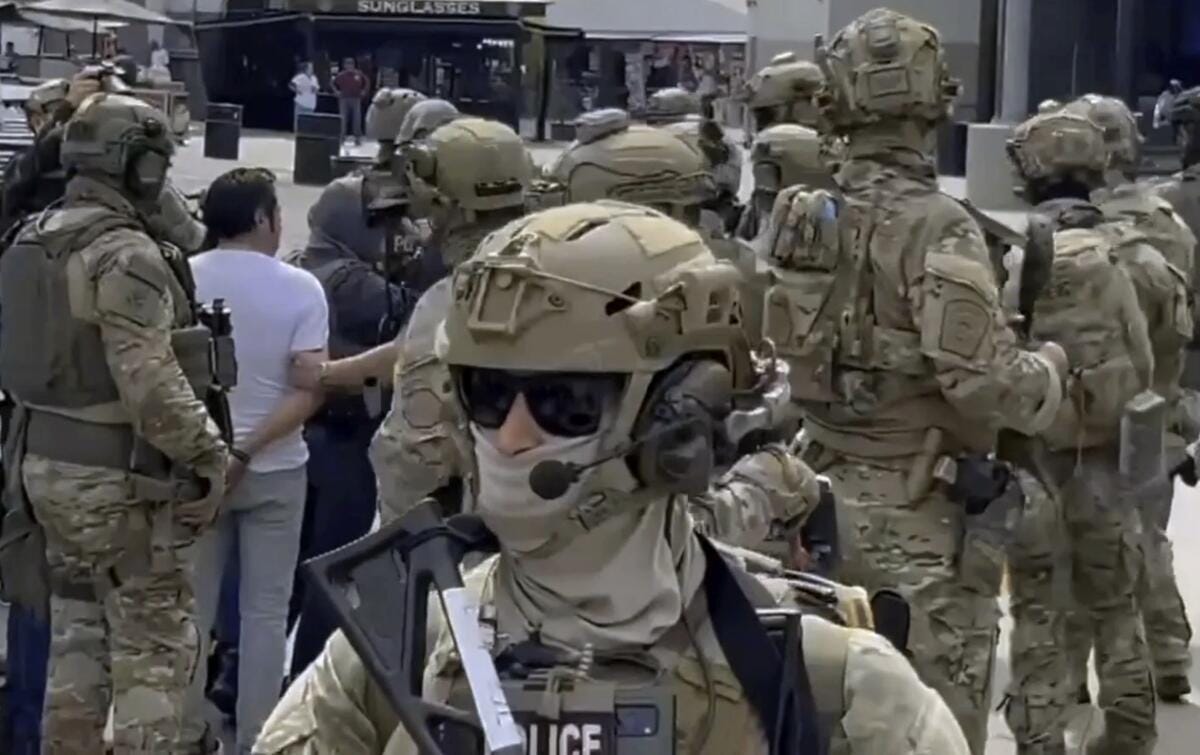
Consider how ICE agents, which constitute a fighting force larger than the military of most nations, are assuming power outside the accountability structures that would govern the police force. The increasing militarization of the domestic space creates a feedback loop: sensational arrests generate headlines that justify further funding and expanded authority, which in turn produce more arrests, including high-profile mistakes, leading to grassroots fighting against ICE agents. (This is, in fact, a dynamic similar to what happened leading up to the Spanish Civil War, with obvious differences. Read Rod Dreher’s 2019 article, “Learning From the Spanish Civil War.”) All this is unnecessary since there were safer and more humane pathways to immigration enforcement that could have been pursued by President Trump but which he chose to reject.
The hysterical anti-immigration mood can also be said to bear the hallmark of a revolution to the degree that it is fueling the us-vs.-them polarity that is increasingly becoming a feature of the woke-right. President Trump has tapped into a primal fear that, once activated or amplified, exists on a visceral level: the fear of the other. This fear, if unchecked by reason, can turn an entire population into beasts, leading to uprisings, revolutions, and even genocides. This is concern is not hypothetical. In some of the professional circles I inhabit, I am witnessing a knee-jerk demonization of foreigners, as legal residents and even naturalized citizens are finding themselves outside the new purity culture of American nationalism. I am watching conservative cultures become colonized by ideas typically associated with leftist revolutions, including ideas of collective guilt, scapegoating, witch-hunting, and the adoption of the victim-oppressor framework as a master narrative for all cultural conflict. I’ve discussed these dynamics in more detail at my Substack article, “MAGA Goes Woke: Will the Real Neo-Marxists Please Stand Up,” but suffice to say that a lot of the rhetoric against foreigners (not merely illegals, but also legal immigrants and even foreign-born citizens) is starting to become eerily similar to the ethnonationalism in Germany leading up to the Kristallnacht of 1938.
None of this is new or uncharted territory, and Americans have a long tradition of debate, and a rich body of wise writings, that could help us navigate these waters. But one of the features of the revolutionary mind is amnesia against tradition. Those attentive to history will know that we’ve been here before. To give only one example, when President John Adams was about to sign the “Alien and Sedition Acts,” which sought to reform immigration while also giving the President unprecedented powers, James Madison wrote a letter to Thomas Jefferson on May 13, 1798 warning that crisis-generated policies against foreigners could result in restrictions of freedom at home. He added that “the loss of liberty at home is to be charged to provisions agst. danger real or pretended from abroad.”
I agree with Madison, and would submit that the current crackdown against foreigners is resulting in loss of liberty at home. Consider, there is a reason many nations have historically kept police and army strictly separate: police and FBI agents enforce the law among citizens they live alongside, while armies project national power against external threats. Accordingly, the police are understood to represent the people, which is why it is always a scandal when a police officer abuses his power. But when the military or a paramilitary force turn their weapons against citizens or legal residents, it gives a dangerous message that the state itself has become the adversary. And this is true even in specific incidents where the use of force may have been justified. When the military or military-like bodies begin operating in the domestic space, this sows distrust, alienation, and the seeds of unrest. And that is exactly what is happening now, as ICE agents are being allowed to function like a para-military body, and to exercise force independent to the accountability structures governing the police. This brings a war-time dynamic to domestic spaces.
This appears intentional, as President Trump’s attempt to invoke the Alien Enemies Act during peacetime signals a deliberate effort to impose wartime conditions within the homeland. This is creating a dangerous precedent that could have consequences beyond anything we can now imagine.
Further Reading
Great article.
Thank you, Robin. We have to face the complex realities involved if we actually want to be agents for good.