

In ethics, we often talk about ethical problems. But ethics itself has become a problem. Ethics is a problem is because we have come to think of morality in ways detached from the rest of life.
Here’s an example.
In 2015, Justin McBrayer wrote a piece for one of the New York Times blogs in which he lamented how the Common Core curriculum had been teaching students that there are no such things as moral facts.
On visiting his son’s second grade open house, McBrayer saw a sign hanging over the school bulletin board sharply distinguishing facts from opinions. While facts were defined as “something that is true about a subject and can be tested or proven,” an opinion was defined as “what someone thinks, feels, or believes.” While reviewing online lesson plans and worksheets about this, Professor McBrayer found the following statements classified as opinions rather than facts:
Copying homework assignments is wrong.
Cursing in school is inappropriate behavior.
All men are created equal.
It is worth sacrificing some personal liberties to protect our country from terrorism.
Drug dealers belong in prison.
These statements—and presumably all similar ethical truth-claims—were all listed as opinions (defined as “what someone thinks, feels, or believes”), and contrasted with facts.
Certainly, there are many problems with defining facts and opinions in this way, not least because opinions can be factual, while facts can include what someone thinks, feels, or believes. But what is significant for our purposes is the idea that factual claims (what we might call “is statements”) belong to an entirely different genus than moral claims (what we might call “ought statements”), the latter being collapsed into mere opinion.
This way of thinking is very diffuse in the contemporary world and has become part of the air we breathe, and it maps onto numerous binaries. For example, consider how we tend to separate claims about what is the case from statements about what ought to be the case. In the former category are facts, descriptions, observations, and evidence-based claims. In the latter category are ethics, moral statements, what we should do, what is right or wrong. And as the story of the second grade class indicates, we sometimes call the latter “just a matter of opinion” to distinguish it from hard facts that are true or false. This leads to the classic fact-values bifurcation that has metastasized in so much of contemporary society.
Doing Ethics in a Vacuum
Now even if these bifurcations aren’t always spelled out so explicitly, we are enculturated to think of moral (or ethical) claims as fundamentally different from factual claims, with the former being more nebulous, and hence “just a matter of opinion.” (“Opinion” here is in scare quotes because in reality opinions can be true or false, and so this is a bad use of the word opinion.)
This goes beyond mere sloppy semantics. As moderns we have been deeply enculturated to think of ethics as detached from the rest of life.
Consider that when people study professional ethics, the learning is often structured in ways that isolate ethics from every other department of life. When you’re studying a field like business or medicine or science or journalism, most of the time you’ll be studying what is the case – the facts for that particular discipline. But a small portion of your classes will also be devoted to studying what you ought to do (usually, actually, what you ought not to do), and we call these ethics classes. For example, someone might take a class in business ethics, or medical ethics, or research ethics, or journalistic ethics. This is often approached as something you need to get out of the way so you can continue with the real meat of the discipline. Thus, in many subjects, ethics start to feel like an add-on, separate from the rest of life. Sometimes the ethics component is even taught by someone from another department. For example, I have a good friend who is part of the philosophy department at his university, and he is brought into med school to teach medical ethics.
In many fields—for example, history, economics, chemistry, and mathematics—the ethics component is optional and offered as an elective.
So ethics often feels detached from the facts, as separate from the rest of life, and thus perhaps “just a matter of opinion.”
Another reason it’s easy to think of ethics as “just a matter of opinion” is because it seems endlessly revisable. The guidelines for research ethics and medical ethics, for example, are voted on my committee and can sometimes change or be updated. That’s why there are certain landmark social experiments from the 70s that can’t be replicated because the ethics code for experimenting on humans has changed.
So there’s a deep sense engrained in us that ethics is separate from the rest of life. And with ethics separate from the rest of life, naturally people wonder if ethics is even real. Is right and wrong merely a matter of feeling?
And that’s a basic problem I want to explore in this essay. I’ll be suggesting that this sense of ethics as detached from the rest of life has a specific pedigree going back about three hundred years to the Enlightenment. I’ll suggest that this correlates with an approach to ethics based on dilemmas, duties, and actions, as well as the sequestering of ethics from our ordinary experience.
But there is a remedy I’ll also be exploring. The alternative is an approach to ethics based on the virtue tradition. In the virtue tradition, duties and actions are integrated with character, human flourishing, and a quest for The Good. This connects ethics much more organically with our everyday ordinary experience in ways that post-enlightenment approaches have not been able to achieve.
But back to the problem. I opened by suggesting that ethics has emerged as a separate discipline detached from the rest of life. It’s important to note that this bifurcation hasn’t always been commonplace.
MacIntyre and the Fragmentation of Ethics
The historian of ethics, Alasdair MacIntyre, wrote a landmark book in 1981 that reframed understandings of ethical history, though MacIntyre’s insights were not novel and built on the thinking of philosopher Elizabeth Anscombe.
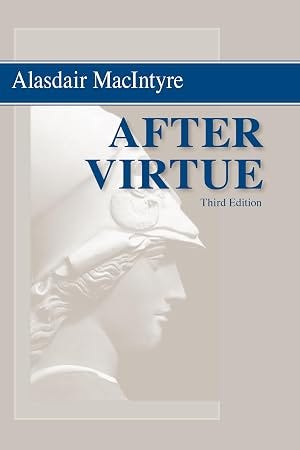
The book, After Virtue, showed that this bifurcation between is and ought (or between facts and values, if you will), is a comparatively recent innovation. It emerged in the seventeenth and eighteenth centuries when the consensus was breaking down about God, human nature, and the purpose of life. During this period, which is often referred to as the Enlightenment, philosophers started seeking to find an independent rational justification for morality. Even if thinkers could no longer agree on human nature, the purpose of human life, or humanity’s final end, and even if they couldn’t agree whether there is a truth about The Good, they still had to answer practical questions like:
Is it always wrong to lie?
Is killing wrong?
Should I keep promises?
Is it ok for the government to take someone’s land?
What makes a conflict a just war?
In order to grapple with these and other questions, philosophers started searching for principles to classify these and other types of actions. They began searching for universal principles that could help them sort through right and wrong, while bracketing such questions from the larger metaphysical and theological issues on which there had ceased to be consensus—questions about life, the universe, God, and the truth about the good.
Looking back we can see that this shift meant they basically started doing ethics in a vacuum. We don’t realize how novel this was, but MacIntyre shows that in Latin there was no word that correctly translates to what we mean by the word “moral.” The English word “moral” actually comes from a Latin word that meant something more like custom or habit, rather than anything approximating an ethical code. The ancient vocabulary of ethics was rooted in concepts like character, habit, excellences, and the pursuit of The Good, rather than an autonomous realm of “moral obligations.” In the older conception, morality and ethics did not exist as disciplines separate from the rest of life but were integrated into one’s whole understanding of the cosmos and human nature. But around the 18th century, ethics began to occupy an autonomous sphere, with rules of conduct that are neither legal nor aesthetic nor phenomenological nor psychological nor political, but occupying a cultural space all their own.
Once ethics becomes an autonomous sphere separated from the rest of life, it’s an easy step to skepticism about right and wrong, or emotivism where right and wrong are defined by feelings.
I remember when I was in California visiting my parents in January 2023, and I spent a few days camping with a friend. We were hiking on The Pygmy Forest Discovery Trail in Van Damme State Park. During the walk we met a couple who invited us to dinner that evening. The man was an unbeliever of the old school rationalist type, and he seemed to have a stereotype about Christians, assuming them all to be unthinking. So when he met me, a thoughtful believer, he was intrigued and asked if we could correspond. As soon as I got back home, he started emailing me questions, like “Can you prove that God exists?” or “How do you know the Bible is true?” I think he half expected me to retreat behind dogmatism and blind faith, but I relished the conversations. At one point, he challenged me to prove that evil exists. At first it seems a silly question. Of course there is a lot of evil in the world, right? Yet within the context of this man’s materialistic worldview, where the only real things are physical, a concept like “evil” seemed a conceptual imposition onto the brute facts of nature—a human interpretation layered onto the raw material of the world. I could see where he was coming from because it is a bit strange to assert there is this realm of good and evil which is neither material, psychological, empirical, phenomenological, aesthetic, or legal, but occupies a conceptual space all its own yet is still somehow said to exist in a meaningful sense. You can see how someone might come to doubt this realm, especially someone who doesn’t accept Christian revelation.
The Gap Between Is and Ought
This skepticism about good and evil, at least in the ethical sense, is often associated with a problem voiced in the 18th century by the philosopher David Hume, who famously argued that one cannot infer prescriptive or value-laden conclusions—basically, “ought” statements—solely from descriptive facts about the world, or “is” statements.
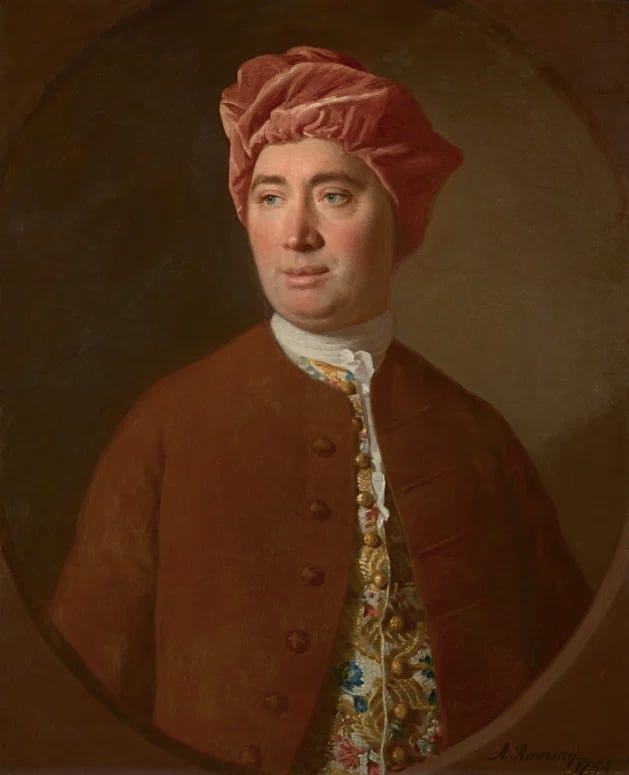
This is known in philosophy as the famous is-ought problem. How do you make the leap from descriptive premises to evaluative conclusions, from facts to values, from is to ought? And if you can’t infer what you ought to do simply from empirical observations, then where do we look to ground ethics? How do you close the gap between facts and values, between is and ought?
But here’s the point: you cannot close the gap in the terms in which the problem has been handed down to us over the past three hundred years, in which ethics occupies a conceptual space all its own separate from other spheres of life.
Today, downstream of the Enlightenment, even our moral vocabulary has been hijacked by this sense in which moral values are sequestered from the rest of life. We can talk about “ought” as in “I ought to eat lunch so I won’t be hungry,” or “I ought to go to bed because I have to get up for work the next day,” yet when we want to talk about ought in the moral sense—let’s say, in the “specifically moral sense of ought” – we mean it in a way isolated from everything else, again as if ethics occupies a space all its own that is neither legal nor aesthetic nor phenomenological but is still somehow coherent.
But this sense of “ought” turns out to be a chimera. When you separate ethics from everything else that is meaningful, there is nothing coherent left. And this is what Alasdair MacIntyre noticed and discussed in After Virtue. In the modern world, we still function as if the concept of ought is coherent, and we still talk about right and wrong, about duties, obligations, etc. but these are mere fragments that have survived from an earlier age that did have a context in which such categories made sense. They do not make sense anymore today. What we actually have are the remnants of an older tradition, but without the larger philosophical infrastructure needed for these remnants to be meaningful. And that has set the stage for interminable ethical debates and unresolvable moral dilemmas.
Trapped in Moral Dilemmas & Colliding Ethical Frameworks
A moral dilemma is something like, if there is a room full of people and the building is on fire, and a fat man is stuck in the window exit, and the only way to open the exit to let everyone out is to cut the fat man into pieces, is it justified to kill him? Would such an action be murder?
My favorite moral dilemma is: if there are three starving men in a boat, is it okay to cannibalize one of them to save the life of the other two?
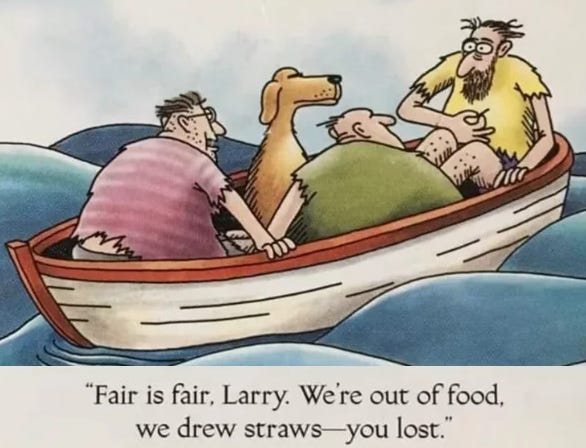
This cartoon here is a joke, but in everyday life we face moral dilemmas all the time. Often everyday moral dilemmas are framed like, “Under what conditions would such-and-such be morally permissible?”
For example, is it okay to get divorced if you fall out of love? Is it okay to kill one person to save a hundred? Is it okay to lie to someone to make them happy? How do I balance truth vs. kindness, loyalty vs. justice?
Sometimes the moral questions we ask aren’t about the individual should do, but about society or government—what should we do? Often these types of questions begin with the word “should.” For example,
Should we use our military to spread democracy abroad?
Should individual freedom give way to the common good?
Should the state prioritize equality of outcome or equality of opportunity?
Should government use tax-payer dollars to support the arts?
To help us answer these and other questions, philosophers have come up with various ethical theories. These include theories such as:
Utilitarianism. An action is good if it produces the greatest happiness for the greatest number
Deontology. The rightness or wrongness of an action is based on whether it follows a set of rules, rather than the consequences of the action.
Divine Command Theory. Morality is solely determined by the commands of a divine being.
Consequentialism. The rightness or wrongness of an action is based on its consequences, rather than the action itself.
Emotivism. Moral judgments do not express factual propositions; rather, they simply express emotional attitudes of approval or disapproval.
Now all this makes ethics rather complicated. For one thing, it’s hard to adjudicate between these different frameworks without first assuming principles internal to one system, in which case any argument you could make for the superiority of one system over another becomes circular. Consider that if I run the dilemma about the three men in the boat through any of these systems, I’ll get a clear answer based on the criteria internal to that specific system; yet how do I adjudicate between these different systems in a non-arbitrary and non-circular way?
This leads to the situation described by Alasdair MacIntyre when he said that moral debates become interminable. They become interminable not just in the sense that they go on and on, but that there is no clear way to adjudicate between different positions since those holding contrary views have different starting points. And isn’t that what we see today in our public discourse, especially about moral and political matters? In debates about how to balance individual liberty with the common good, or debates about equal treatment vs. compensatory justice, or free speech vs. social responsibility, we find adherents to one side have starting assumptions that are completely incommensurate, and so discourse is reduced to mere posturing and performative outrage.
It’s not hard to see why people come to the conclusion that ethics is merely a matter of opinion—something fundamentally different from the world of facts—thus reinforcing the is-ought gap and the fact-value bifurcation we discussed earlier.
A Different Way to Think About Ethics
But there is a remedy. The alternative is an approach to ethics grounded in the virtue tradition. In the virtue tradition, ethics is integrated into the rest of life, so that ethics is not some free-standing autonomous sphere disconnected from all the other meaningful departments that make up our experience.
In the ancient world, including the world of the Bible, the central question of ethics was not, “What should I do?” but “What kind of person do I need to become to flourish?”
Simply asking this question resituates ethics in terms of character and the virtues. Instead of starting with abstract questions and principles and trying to figure ethics out and then going into the real world to apply our theories, we start in the real world with actual people and their needs.
We all want to flourish. We all want to be the best version of ourselves that we can be. And all of us recognize, on a deep intuitive level, that in order to flourish, we need certain character traits or virtues.
This virtues-based approach is the solution to the problem of the Enlightenment because it returns ethics to the everyday world of common experience. But that requires some unpacking.
In the classical tradition—“classical” understood in the broadest sense to include not only the ancient Greeks and Romans, but also the Chinese—the virtues have been understood to be the traits constitutive to flourishing. Then the whole question of ethics becomes much more meaningful and practical. It becomes practical because this tethers ethics to vocation. For as soon as we ask, “What kind of person do I need to become to flourish?” the question is raised, “Flourish for what?” And the answer will be different for each vocation.
For example, to flourish as a ship builder, a man or woman needs virtues like
industriousness
conscientiousness
thoroughness
attention to detail
To flourish as a warrior, a man needs virtues like
courage / fortitude
cunning
endurance
vigilance
Notice how the distinction between is and ought collapses. If Johnny is a ship-builder then he ought to do what a good ship-builder does. We move from is to ought by looking at a role and the good that this role seeks to serve. When Johnny has the virtues that enable him to move toward the good his role seeks to serve, then he achieves some level of human flourishing.
Of course, this assumes that there is a built in good that things are aimed at. This of it like this. The good of an acorn is to grow into an oak tree; the good of a baby giraffe is to grow into a full-grown giraffe and eat leaves; the good of an eye is to see.
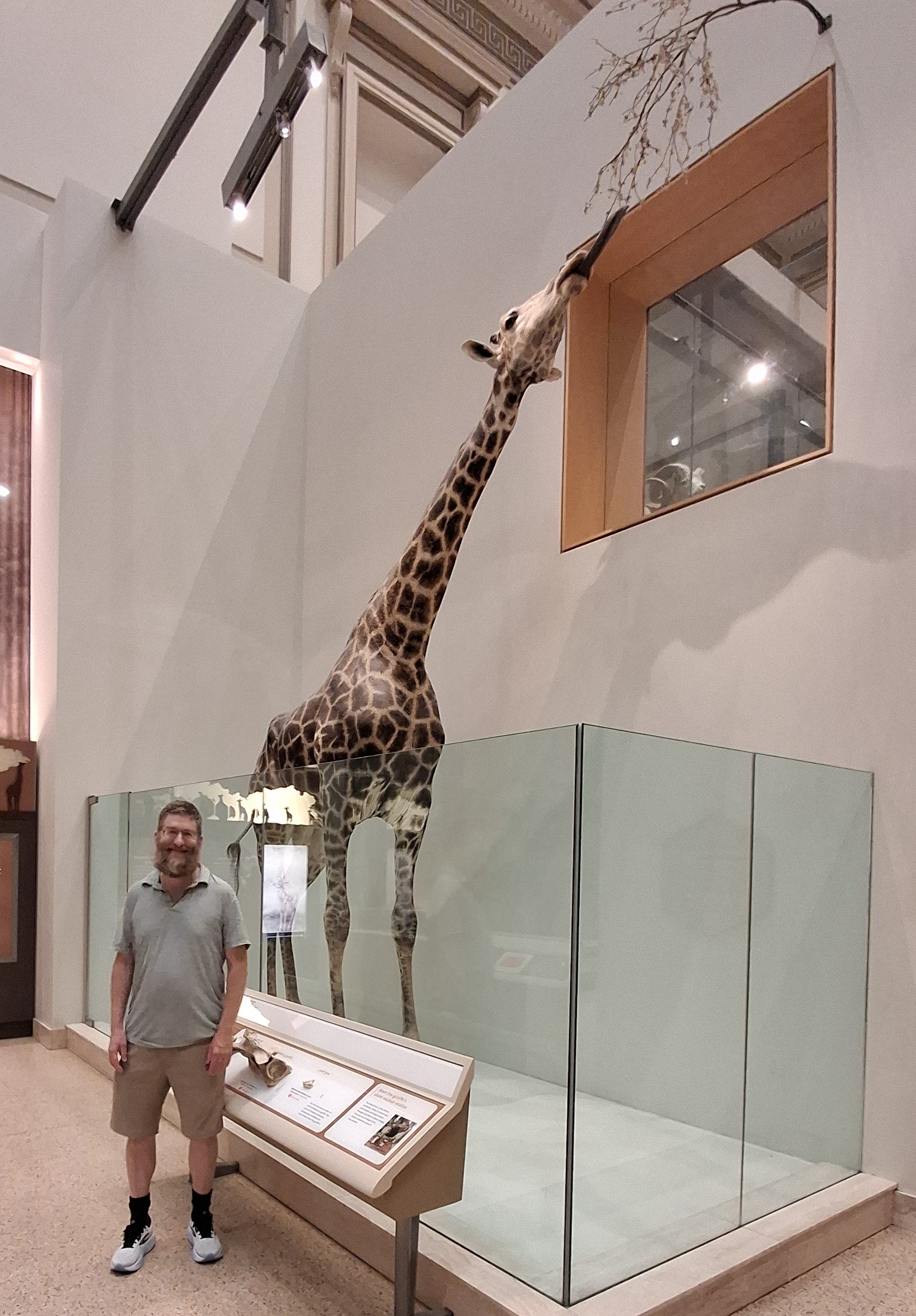
Roles and vocations are also aimed at different goods. I gave examples of a ship-builder and warrior, but consider a mother. To realize the good internal to the role of mother, a woman needs virtues like,
kindness
patience
self-sacrifice
attention
love
Here again we move from “is” to “ought” by looking at a role and the good the role seeks to serve.
To flourish as a philosopher (or even just a thinker), a man needs virtues like,
critical thinking
fair-mindedness,
inquisitiveness,
intellectual honesty
thoroughness
cognitive empathy
curiosity
We call these epistemic virtues. These epistemic virtues fulfil my role as a thinker, or perhaps even a philosopher.
To flourish as an artist (painter, musician, dancer, etc.), a person needs aesthetic virtues. In a future post I am collaborating on with Light On Ascent, we will be taking a deeper look at the aesthetic virtues, but for now suffice to say that these include traits such as,
judgment
taste
creativity
receptivity
attention to detail
patience
openness
These aesthetic virtues enable a person to be fulfilled in his or her role as an artist.

So there are virtues distinct for each vocation. Each role or vocation has a good to pursue, and the virtues associated with that role will enable the man or woman to achieve that good. Virtues enable men and women to achieve the goods internal to practices, but it also enables them to pursue the good of a whole human life.
The Good of the Human Being
To approach the good of a whole human life, we need to add some important qualifications to what I’ve said up to this point. While role-specific excellence is necessary for achieving a coherent account of ethics, it is not sufficient. A Nazi officer or slave trader could be extraordinarily excellent at his “role,” and that would be bad. And maybe a man rises to become the best ship-builder in town because he’s cheating on his purchases of wood.
So at some point we have to ask, what about the vocation of a human being? Just as the good of an acorn is to grow into an oak tree and the good of a ship-builder is to build good ships that will float and not sink, is there a good for human beings as such? What is the good toward which human nature is ordered?
Of course, to answer this, I must have an idea about what the telos or final cause of a human being is. Just as the goal or telos of an acorn is to grow into an oak tree, so the goal of humans is to achieve happiness in God. It is through beatitude that we fulfil our nature. And there are virtues that assist us toward that goal—virtues that help us not simply be a good shipbuilder or warrior or artist, but to be a good person. These include virtues like
humility
self-control
patience
gratitude
prudence
empathy
decisiveness
constancy
perseverance
wisdom
magnanimity
temperance
courage / fortitude
humility
hope
generosity
faith
love
This is just a sampling, and not exhaustive. These virtues are ways of training ourselves, and they are ultimately tied to the pursuit of wisdom and the achievement of beatitude.
Now one could say that the role of a good human being, no less than the role of ship-builder, mother, artist, etc., only describes what we want, or that these roles are forced on us, or are simply considered good by society. Or maybe claims about the virtues that help people flourish are merely emotional claims describing merely what I want someone to do, so morality becomes a way to manipulate people. In discussing this in his lecture on MacIntyre for the Great Courses’ series on “Great Minds of the Western Intellectual Tradition,” my friend Philip Cary from Eastern University reminds us that what you really need is a truth about The Good. A truth about The Good is what they lost at the Enlightenment. A truth about The Good is what prevents virtue from collapsing into mere emotivism, subjectivism, or even relativism. In 2019 I discussed this with Dr. Philip Cary in an engaging conversation that you can watch below. (Dr. Philip explains it much better than I’m doing here.)
Consider, to talk about the specific good for any thing or role, is eventually to be pushed up to a higher order of good. To talk about the good internal to human beings assumes we have a sense of the good to which human activity is coordinated. And once we begin asking what is the good toward which human activity is coordinated, we find that particular human goods cannot simply float free of one another. The various things we call good—knowledge, friendship, health, justice, beauty, and so forth—must themselves be understood as parts of a larger account of The Good - capital G. But for this to be coherent we need to have a larger metaphysical horizon in view. In the classical Christian tradition, that metaphysical horizon is The Good and ultimately God, the final plentitude of all Goodness, Truth, and Beauty. This provides us with a truth about the good that gives meaning to our experience as rational spirits.
But why a final or ultimate Good? Well, consider how, as rational creatures, we never desire an object for what it is in itself; we only desire an object as it is deemed to be good, or true, or beautiful. From the earliest age, a child asks questions because he or she is hungry to understand the world. But the quest for truth would not animate a rational spirit if Truth Itself were not inherently desirable. Or again, I desire the good of friendship, justice, etc., but only because Goodness is itself an inherent object of desire. I desire the beauty of an artwork or the beauty of a well-ordered soul because Beauty is itself an inherent object of desire. And this primal desire for Goodness, Truth, and Beauty is ultimately a desire for God Himself.
Even disordered desires for things like drugs or carnal pleasures are pursued because the person thinks it will be good “for me” even if only in an immediate and finite sense. But that desire for even finite, temporary or misplaced goods assumes a prior desire for goodness, truth, or beauty. If truth, goodness, and beauty were not inherent objects of desire, then finite desires—even those that take something bad to be good—would not have the pull that they do. If we didn’t desire goodness for the sake of goodness, no object could incite the affections and finite desire would be impossible. (If you’re not convinced of this, please read David Bentley Hart’s delightful little book You Are Gods: On Nature and Supernature.)
From Moral Dilemmas to Human Flourishing
So there is a truth about the good that animates human actions and is the ultimate basis of the ethical endeavor. But when we lose any sense of a truth about the good (which has been the history of ethics since the 18th century, perhaps even earlier going back to the 16th century), and when we seek to create a body of moral obligations separate from a truth about the good, then ethics becomes purely incoherent and gets stuck in unresolvable dilemmas. The is-ought gap, the fact-value gap, the separation of ethics from the rest of life are all symptoms of this loss—the loss of a truth about the good.
The loss of a truth about the good accounts for the present situation where the virtues have survived in a fragmentary form, disengaged from all the connective tissue that gives them coherence. Now the virtues wander alone, a survival from an earlier age in which they made sense. It isn’t that we no longer have ideas like justice, fairness, courage, or compassion, but that, detached from the larger framework that once gave them meaning, these virtues have often morphed into distorted versions of themselves and can be taken up or dropped in scattershot fashion, without ever being coordinated toward ultimate—or even proximate—ends. G.K. Chesterton realized this, decades before Alasdair MacIntyre wrote After Virtue, when he made the following observation:
The modern world is not evil; in some ways the modern world is far too good. It is full of wild and wasted virtues. When a religious scheme is shattered (as Christianity was shattered at the Reformation), it is not merely the vices that are let loose. The vices are, indeed, let loose, and they wander and do damage. But the virtues are let loose also; and the virtues wander more wildly, and the virtues do more terrible damage. The modern world is full of the old Christian virtues gone mad. The virtues have gone mad because they have been isolated from each other and are wandering alone. Thus some scientists care for truth; and their truth is pitiless. Thus some humanitarians only care for pity; and their pity (I am sorry to say) is often untruthful.
Chesterton’s insight is even more prescient today as the order of Wokeism—in both its left-wing and right-wing iterations—has taken the do-goodism of our residual Christian instincts and turned it against Christianity. But I digress.
When we have a truth about the good, then there is a good for humans, just as there is a good for acorns and giraffes. And just as an acorn needs nutrients and sunlight to realize its inner capacity for becoming an oak tree, so humans need the virtues for realizing their inner capacity to grow toward their ultimate telos, which is beatitude in God.
Notice that now ethics is no longer detached from life—the virtues are no longer roaming wild disengaged from their metaphysical moorings. But the virtues, thus understood, are also more practical, for now there is a reciprocity between what you do and who you are – who you’re becoming. Doing the right thing forms habits so you become a certain type of person – so that you can develop character over time. This enables you to flourish as a human being which, in turn, allows you to be a better friend, a better spouse, a better parishioner, a better citizen.
A virtue-based approach, thus conceived, is metaphysical insofar as it has a sense of our ultimate telos in God, but it is also much more practical. Situating ethics within the classical Christian virtue tradition allows an important role for intelligence and practical reasoning. Wise and virtuous choices emerge out of years of reflection on the Good, the True and the Beautiful over time. Think back to the men in the boat. What we really need to ask is, “What type of person do I need to become so that in a life-or-death situation, I instinctively know what to do, and automatically do the right thing?” Unless I have spent a lifetime developing the virtues, I might not know what to do when confronted with a difficult moral dilemma. Or, if I have not spent a lifetime developing habits of virtue, I might know the right thing to do but be incapable of performing it during a crisis, or be incapable of acting virtuously when its hard and comes at a high cost.
Reconnecting Ethics to Life
I’ve suggested that modern ethics has become detached from the rest of life, through the separation of facts from values, the separation of is from ought, and the partitioning of ethical reasoning from our understanding of human nature and the purpose of existence. The result is an ethical landscape dominated by seemingly endless moral dilemmas and competing theories, with no shared framework for adjudicating between them.
The virtue tradition offers a different approach. Rather than beginning with the question, “What should I do?”, it begins by asking, “What kind of person should I become?” Virtue connects our actions to character-forming habits, and it connects character with vocation and thus to human flourishing. By looking at the goods internal to particular roles, we come to the question, “What is the good for human beings as such?” Ultimately, this requires a truth about the Good—a metaphysical horizon of ultimate Good that animates and gives coherence to our desire for finite goods.
Once ethics is grounded in this larger vision of reality, the supposed divide between is and ought collapses. Ethics is no longer an abstract system of rules imposed upon life, but an integral part of learning how to become the kinds of people we were created to be. And that inevitably leads us into questions about growing to be virtuous not merely in external behavior, but also in our hearts and feelings, as our affections are gradually healed. That will be the topic of the next lesson in this series on the virtues, in which we will also explore the cardinal virtues and how they relate to growing closer to God. You can view the next lesson at the link below.
Further Reading
The Battle for Your Child’s Imagination: Why Stories Matter More Than You May Think
The Culture of Community: Relearning Communion in an Age of Isolation with Robin Phillips
Ancient Faith Today - How Not to Be Gnostic (w/ Robin Phillips & Dr. Phillip Cary)
Virtue and Classical Education: A Commencement Address to a Graduating Class
Robin, this was so well done. It’s poignant and captures a wealth of wisdom in a condensed and effective way. Thank you so much.
very nice article. macintyre is an intellectual hero of mine. and of course, a shoutout to aristotle and the boys. the decline in classical education is a travesty.