
Is AI Magic?
How Medieval Magic Became Artificial Intelligence—and Why Reading About It Doesn't Make Me a Wizard

Earlier this week, when reading Tolkien’s letter to Milton Waldman of 1951, I was struck by his association of magic with the Machine.
Tolkien describes his legendarium as “mainly concerned with Fall, Mortality, and the Machine” and then explains how fallen beings express their rebellion in machinery and magic.
“He will rebel against the laws of the Creator - especially against morality. Both of these (alone or together) will lead to the desire for Power, for making the will more quickly effective, - and so to the Machine (or Magic). By the last I intend all use of external plans or devices (apparatus) instead of development of the inherent inner powers or talents - or even the use of these talents with the corruptive motive of dominating: bulldozing the real world, or coercing other wills. The Machine is our more obvious modern form though more closely related to Magic than is usually recognised.”
The association of the Machine with magic may appear an odd juxtaposition, but it has an ancient pedigree, and one which, I’m convinced, contains a key to understanding AI. Tolkien presciently grasped a point that has come into sharper focus in recent years, namely that the high-tech wizardry of our age is driven by many of the same ambitions that drove ancient magic: to cheat death, accumulate power, and bend other wills to our own.


Last year, when developing this hypothesis for chapter 12 of our book, Are We All Cyborgs Now?, I did some reading about ancient magic, and was struck by the similarity between medieval magic and the new techno-utopian wizardry of artificial intelligence.


Recently, one of Jay Dyer’s followers, who has devoted a remarkable amount of time to denouncing me online—and who has constructed an elaborate theory in which I am a liberal operating a feminist dummy account while masquerading as a conservative Orthodox academic in order to ingratiate myself with Rod Dreher—came across a picture of me reading Richard Kieckhefer’s Magic in the Middle Ages. Commenting on it, the gentleman announced this was a final vindication of his contention that I am “a subversive academic from an off-the-rails ecumenist parish" who is promoting Hermeticism and Neoplatonism. (Well, I don’t mind owning that I am a closet Neoplatonist if it comes to that.)
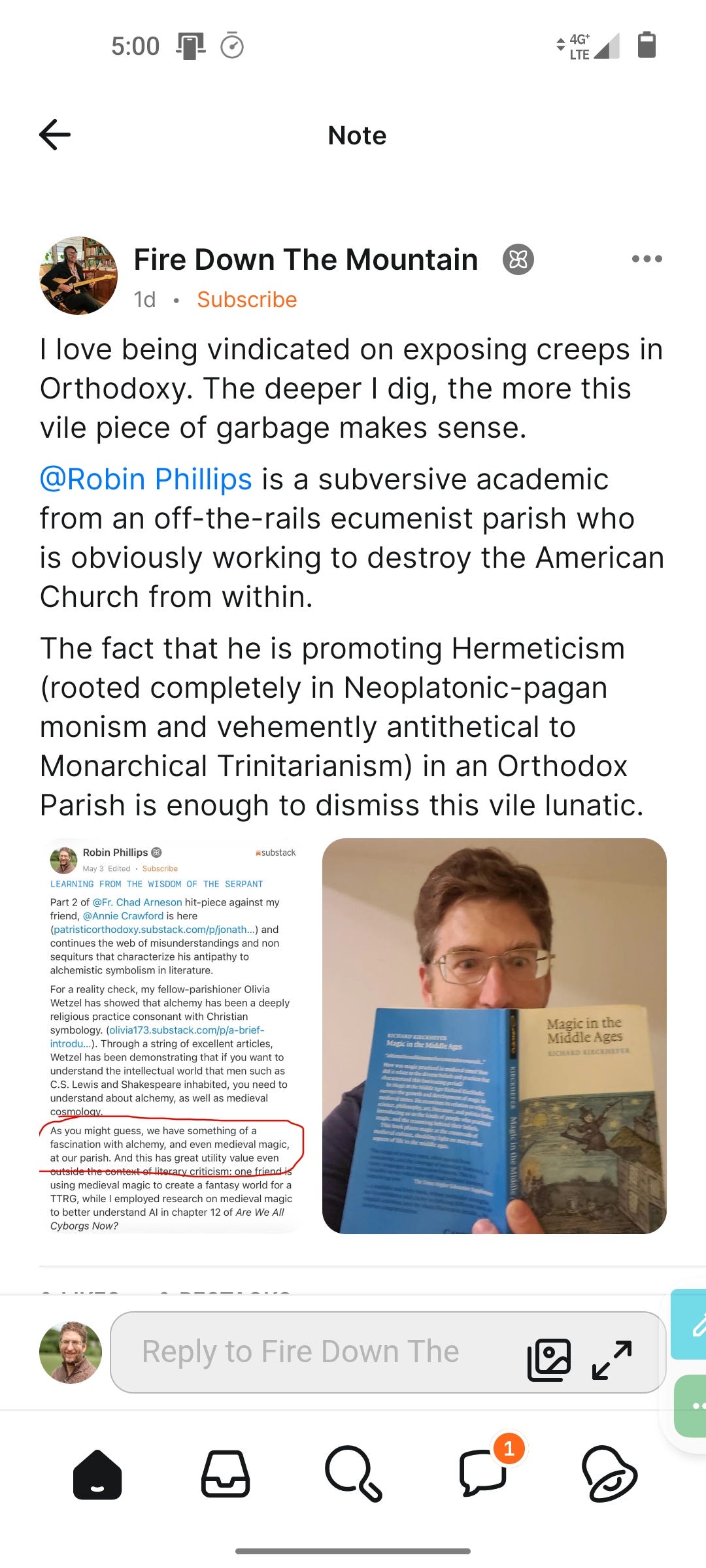
This seems to be a common pattern: any interest in medieval symbolism or intellectual history is immediately transmuted, through some alchemy of interpretation, into proof of occult affiliation or ideological subversion. For example, in talking about alchemical symbolism in C.S. Lewis’s Space Trilogy, Annie Crawford had to clarify on Twitter that she had “no desire to encourage occult practice” after Fr. Chad Arneson accused her of descending into woo woo. And while I have already clarified that my interest in medieval magic has been in the context of critical engagement with AI, it seems I wasn’t clear enough.
So to set the record straight, I want to share the relevant portion of Are We All Cyborgs Now? where I discussed the magical pedigree behind AI. In this section, I have identified four types of magic from the Middle Ages, all of which I argue coalesce in the modern technological project. (And although my critics will be disappointed, I am not currently practicing any of these four forms of magic. Nor does reading about ancient magic make me a wizard.)
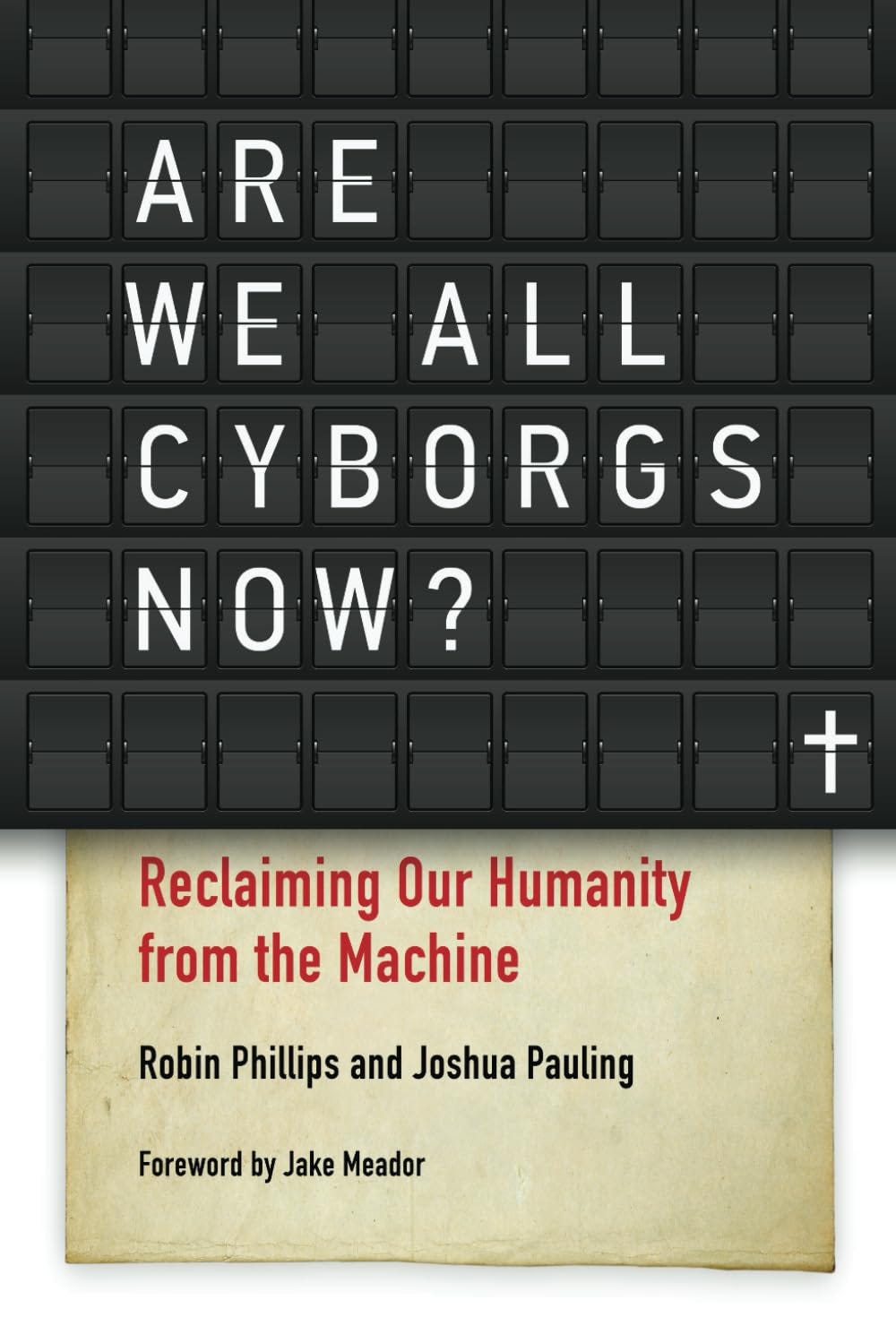
Is AI Magic? An extract from chapter 12 of Are We All Cyborgs Now?
At the close of the millennium, David Noble published a book titled, The Religion of Technology, in which he explored the spiritual underpinnings beneath the modern technological vision. In the book’s introduction, Noble commented on the strange fusion of rationalism and spirituality that now animates the techno-utopian impulse:
Although today’s technologists, in their sober pursuit of utility, power, and profit, seem to set society’s standard for rationality, they are driven also by distant dreams, spiritual yearnings for supernatural redemption. However dazzling and daunting their display of worldly wisdom, their true inspiration lies elsewhere, in an enduring, other-worldly quest for transcendence and salvation.[1]
Noble, himself an historian, shows that when technological innovation first began to emerge in the Middle Ages, it was directly tied to a vision of spiritual progress, and even connected to the Christian idea of redemption. Similarly, from the Industrial Revolution through to the contemporary era, there has been a constant fusion of spirituality and technology. Noble thus found it strange, when writing at the dawn of the 21st century, that most people had come to think of technology/science and spirituality/transcendence as contrary historical forces:
With the approach of the new millennium, we are witness to two seemingly incompatible enthusiasms, on the one hand a widespread infatuation with technological advance and a confidence in the ultimate triumph of reason, on the other a resurgence of fundamental faith akin to a religious revival. The coincidence of these two developments appears strange, however, merely because we mistakenly suppose them to be opposite and opposing historical tendencies.[2]
Twenty-two years later, David Noble’s point is easier to accept. The gurus of Silicon Valley no longer disguise the spiritual cast to their endeavors as they pursue their techno-utopian social vision with religious zeal and fanaticism.
The intersection of religion and technology has seen the rise of a new mysticism, with what Wesley Wildman and Kate Stockly refer to as “the brave new world of consciousness hacking and enlightenment engineering.”[3] It has seen the rise in a new eschatology, known as the doctrine of the Singularity. It has seen the emergence of a new corpus of prophetic literature, such as Ray Kurzweil’s The Age of Spiritual Machines[4] and David Chalmers Reality+.[5] The techno-spiritual order even offers its own vision of transcendence, with the pseudo-mystical cluster of ideas that now surround the theories of bot consciousness. Even the economic and media structures on which technology depends revolve around a kind of magic, as the Romanian philosopher, Ioan P. Culianu, observed.
Nowadays, the magician busies himself with public relations, propaganda, marketing, publicity, information, misinformation, and counter-information, with censorship and cryptography — a science which was in the 16th century a branch of magic… Historians have been wrong in concluding that magic disappeared with the arrival of “quantitative science.” The latter has simply substituted itself for a part of magic while extending its dreams and goals by means of technology.”[6]
The engineers, venture capitalists, and programmers at the heart of this endeavor have been quite open about the religious nature of their quest, especially when it comes to AI. To quote from Joshua Schrei, in a piece that has been widely discussed throughout Silicon Valley, [13]
And the programming architects at the center of this magic have been very open about it. They’ve directly said over the years that the AI issue is more religious than scientific. Some have even compared themselves directly to sorcerers… Writers and philosophers and even some AI architects themselves have said since the 60s that the fundamental questions underpinning AI are actually religious questions. Questions of apocalypse, salvation, of power and sentience. These are deeply important questions — and AI is bringing all of them to the surface. And showing us yet again, that the world we inhabit is mysterious, and the primary questions facing us are spiritual questions.[14]
Within the religion of technology, mystery functions more like it did for ancient savages than in the monotheistic religions. Like a primitive savage whose world is haunted by demons and shadowy forces, we may soon live in a shadowy netherworld where the phantasmic is mistaken for the real. Indeed, as more aspects of reality come to be mediated through our machines, the distinction between actuality and simulation, real intelligence and artificial intelligence, genuine information and fake information, become not only porous, but trivial and irrelevant for many.[15]
In his 1999 book Technology as Magic: the Triumph of the Irrational, Richard Stivers identified a strange juxtaposition of the rational and the irrational, observing that our technological society offers extensive rational control juxtaposed with “the need to escape into fantasy, dreams, and ecstasy.”[16] The fixation with escaping from reality—manifested in everything from gaming to the transcendent aspirations of the transhumanist movement—threatens to blur the distinction between the real and the fake, the rational and the irrational. This escapism, rooted in man’s hunger for transcendence, offers a type of reverse sacramentalism to a world where years of rationalism and materialism has left him starved for transcendence. As the French sociologist, Jacques Ellul, put it, “the desacralization of nature, of the cosmos, and of the traditional objects of religion is accompanied by a sacralization of society as a result of technology.”[17] Ellul understood that as the world becomes emptied of mystery, transcendence, and wonder, the sacralization of technology promises to fill the vacuum:
“In the world in which we live technique has become the essential mystery, and that in diverse forms according to milieu and race. There is an admiration mingled with terror for the machine among those who have retrained notions of magic.”[18]
I have been using the word “magic,” following Josh Schrei’s idea that magic lies at the heart of digital culture. “But,” someone will point out, “the modern technological quest is not animated by real magic.”
“Magic” is a tricky term that requires a careful definition—four definitions, in fact.
Magic originally meant “the arts of the magi,” to reference the skills and knowledge of Zoroastrian priests from Persia whose influence extended to the classical world and Southern Europe. The learning of these magi, no less than their claims to cure people through mysterious ceremonies, seemed exotic to those in the Mediterranean lands and accounts for the association between “magic” and the exotic that remains to this day.[20]
In time, Christians encountered “magic” from sources other than the magi. As Christendom expanded into Europe, believers confronted witches and wizards who used a variety of techniques and mechanisms—including divination, fortune-telling, sorcery, and necromancy—to manipulate non-human intelligences. Thus, we can posit our first definition of magic.
Definition of “Magic” #1). The use of techniques and mechanisms to manipulate and communicate with non-human intelligences.
In the Middle Ages, the term magic was mainly confined to philosophical and theological literature. On ground level, however, it was not always clear when a special cure or procedure might involve licit knowledge from philosophia naturalis (what later becomes natural science) or magic, or a combination of both. We see this in the trope of the witch who is learned in both herbology and, so-called, magic potions (the magic potions themselves often concocted from knowledge of plant lore). “The word magic is mainly an abstract and analytical term used in the theological literature. Practitioners more often described the purposes their operations served (e.g., healing, cursing, arousing love), without troubling to place these operations in an abstract category such as magic.”[21]
Around the thirteenth century, some thinkers began to address this ambiguity by distinguishing between demonic magic and “natural magic,” the latter including the marvelous and hidden (occult) powers, processes and procedures of nature that would later fall under natural science. This included many natural powers or processes (including those we no longer consider scientific, such as alchemy, the special powers of gemstones, the influence of the planets on terrestrial life, etc.), and differed from the manifest powers of a thing that could be explained without reference to external forces.[22] Some thinkers, like Aquinas and Roger Bacon, reserve “magic” for things involving sorcery and divination and use virtutes occultae (occult powers) to describe hidden powers in nature. But most medieval people did not make such a distinction although they may have had a vague understanding of the difference between white and black magic. On ground level, however, these distinctions tended to be blurry, and few people would have been able to specify the difference between a charm and a cure. With these qualifications in mind, we can posit our second definition of magic:
Definition of “Magic” #2). Natural magic, where one deals with marvelous and hidden properties and processes of nature.
In practice, natural magic was believed to have the potential to produce results that might appear, on the surface, like illicit magic. We see this in the famous story of the mechanical head constructed by Thomas Aquinas’s teacher, Albertus Magnus. The author of a 1337 text describing the head is at pains to clarify that while the mechanical head could speak and reason (essentially an early version of AI), it was not through demonic power but instead through the great philosopher’s knowledge of the planets and their rotations.
“We find that Albertus Magnus, of the Preaching Friars, had such a great mind that he was able to make a metal statue modeled after the course of the planets, and endowed with such a capacity for reason that it spoke: and it was not from a diabolical art or necromancy—great intellects do not delight in such things because it is something that makes one lose his soul and body; such arts are forbidden by the faith of Christ. One day a monk went to find Albertus in his cell. As Albertus was not there, the statue replied. The monk, thinking that it was an idol of evil invention, broke it. When Albertus returned, he was very angry, telling the monk that it had taken him thirty years to make this piece and “that I did not gain this knowledge in the Order of the Friars: The monk replied, “I have done wrong; please forgive me. What, can’t you make another one?” Albertus responded that it would be thirty thousand more years before another could be made, as that planet had made its course and it would not return before that time.”[23]
The story of Albertus Magnus’s talking head is also valuable in indicating that even in a pre-scientific age, medieval man understood the distinction between something powered by demonic arts, and something powered by natural and mechanical means, though the monk in the story mistook the latter for the former. This story also illustrates how the influence of the planets, though part of virtutes occultae, was seen as separate from the diabolical arts, and more aligned with what we would call science. Yet in practice, the distinction between planetary influence and demonic influence was often blurry, as seen in the legend of the werewolf, whose demonic abilities were, in some sense, powered by the full moon.
Thus, we can posit our third definition of magic.
Definition of “Magic” #3). Automata / robots.
Medieval man also understood stage magic—sleight of hand. When discussing types of magic, John of Salisbury’s (1120–1180) includes illusions (praestigia). We need not dwell on this but can simply posit a fourth definition of magic.
Definition of “Magic” #4). Prestidigitation or “sleight of hand.”
What is curious about our digital technology, and especially AI, is that it integrates all four of the medieval senses of magic.
Let’s start with the fourth and work backwards. Clearly, people can perform various tricks with AI, such as perpetuating the growing illusion that chatbots are sentient. Even the term “artificial intelligence” hinges on the illusion that these systems actually think in what amounts to a digital sleight of hand.[24]
But these systems are also magical in sense #3, as they represent a modern equivalent of Albertus Magnus’s mechanized talking head.
These systems also involve magic in the second sense, where one manipulates the marvelous and hidden properties and processes of nature. Though we do not still use the medieval distinction between manifest and hidden powers, if ever anything qualified for the latter it would be AI. Consider, AI involves harnessing the hidden properties of the world (i.e., electrical energy, magnetism, optics), just as it involves discovering the hidden processes of nature (i.e., the processes we’ve discovered for turning rocks into mechanical heads, which is to say, to turn quartz into the high-purity single-crystal silicon wafers used in microprocessors).
What is perhaps especially fascinating is to see AI increasingly harnessed for the first sense of magic, as people believe they can use it to communicate with non-human intelligences—both those thought to reside in the systems themselves, as well as intelligences within the spirit realm (a point I have discussed in more detail in an article for The Symbolic World and in the video below from the 2025 Paideia conference). In fact, you may not have realized it, but the leaders of some of the largest tech companies in the world are hoping to use AI to merge with non-human intelligences in a coming synthesis of biological and digital life. Clearly, this qualifies as magic according to the first sense, namely the use of techniques and mechanisms to manipulate and communicate with non-human intelligences.
Thus, it is no exaggeration to say that today’s technological enterprise, and the larger scientific endeavor that undergirds it, is the true successor of ancient magic. As C.S. Lewis explained in The Abolition of Man.
The fact that the scientist has succeeded where the magician failed has put such a wide contrast between them in popular thought that the real story of the birth of Science is misunderstood. You will even find people who write about the sixteenth century as if Magic were a medieval survival and Science the new thing that came to sweep it away. Those who have studied the period know better. There was very little magic in the Middle Ages: the sixteenth and seventeenth centuries are the high noon of magic. The serious magical endeavor and the serious scientific endeavor are twins: one was sickly and died, the other strong and throve. But they were twins. They were born of the same impulse… There is something which unites magic and applied science while separating both from the “wisdom” of earlier ages. For the wise men of old the cardinal problem had been how to conform the soul to reality, and the solution had been knowledge, self-discipline, and virtue. For magic and applied science alike the problem is how to subdue reality to the wishes of men: the solution is a technique; and both, in practice of this technique, are ready to do things hitherto regarded as disgusting and impious—such as digging up and mutilating the dead.[25]
If Lewis were writing today, he might choose different examples, such as digitally “resurrecting” the dead and mutilating the living. He would also find more than abundant confirmation for this understanding that, far from sweeping magic away as is often thought, modern science and engineer stands in continuity to the quest of the ancient magician.
Further Reading
Digital Totalitarianism: How Technological Mission Creep Could Destroy Society
Toolkit of Digital Boundaries for Healthy Living How I Reclaimed My Life From the Machin
The Battle for Your Child’s Imagination Why Stories Matter More Than You May Think
Notes
[1] David F. Noble, The Religion of Technology: The Divinity of Man and the Spirit of Invention (New York, NY: Penguin Publishing Group, 1999), 3.
[2] Noble, 3.
[3] Wesley J. Wildman and Kate J. Stockly Ph.D, Spirit Tech: The Brave New World of Consciousness Hacking and Enlightenment Engineering (New York, NY: St. Martin’s Press, 2021).
[4] Ray Kurzweil, The Age of Spiritual Machines: When Computers Exceed Human Intelligence (New York, NY, 2000).
[5] David J. Chalmers, Reality+: Virtual Worlds and the Problems of Philosophy (New York, NY: W. W. Norton & Company, 2022).
[6] Ioan P. Culianu, Eros and Magic in the Renaissance (Chicago, IL: University of Chicago Press, 1987), 104.
[8] L. M. Sacasas, “The Analog City and the Digital City,” The New Atlantis, Winter 2020, https://www.thenewatlantis.com/publications/the-analog-city-and-the-digital-city.
[9] Kent Anhari, “Bot Anxiety,” The New Atlantis, Summer 2021, https://www.thenewatlantis.com/publications/bot-anxiety.
[10] “BJ Campbell, who brought the word into some focus...was struck by the way that on internet social networks, morality is outsourced away from the individual and onto the network. But there is no code of morality here—the moral codes seem to constantly, arbitrarily change. We could say that here we have a situation in which neither individual humans nor an organised group of humans are making decisions about what the group morality should be. But neither is it an algorithm, or any other known entity or intelligence. Thus Campbell, although he doesn’t appear to have any occult background, happened upon the word ‘egregore’ to refer to a semi-agentic ‘emergent’ group entity which could be said to ‘hold’ real power, in this case some control over the morals of individuals.” Daniel Townhead and Kenneth Michael Florence, “The Symbolic World vs Egregores, Part 1,” June 5, 2022, https://thesymbolicworld.com/content/the-symbolic-world-vs-egregores-part-1.
[11] Leng Shumei and Huang Lanlan, “Bringing Back Deceased Beloved Ones through AI Technology Becomes a New, Controversial Business in China as ‘Era of Digital Humans’ Approaches,” Global Times, March 28, 2024, https://www.globaltimes.cn/page/202403/1309721.shtml.
[13] Josh Schrei, “AI in the Age of Mythic Powers,” The Bigger Picture, March 14, 2024, https://beiner.substack.com/p/ai-in-the-age-of-mythic-powers-by.
[14] Schrei, “AI in the Age of Mythic Powers.”
[15] For examples of this, see chapter 10 in Robin Phillips & Joshua Pauling, Are We All Cyborgs Now? Reclaiming Our Humanity From the Machine (Basilian Media, 2025).
[16] Richard Stivers, Technology as Magic (New York, NY: Continuum, 2001), 203.
[17] Jacques Ellul, The New Demons, trans. C. Edward Hopkin (New York, NY: Seabury Press, 1973), 67.
[18] Jacques Ellul, 72.
[19] Hermann Broch, The Sleepwalkers (New York: Vintage, 1996), 448 & 646.
[20] Richard Kieckhefer, Magic in the Middle Ages (New York, NY: Cambridge University Press, 2004), 10.
[21] “Magic: Magic in Medieval and Renaissance Europe .” Encyclopedia of Religion. Encyclopedia.com. (April 15, 2024). https://www.encyclopedia.com/environment/encyclopedias-almanacs-transcripts-and-maps/magic-magic-medieval-and-renaissance-europe
[22] These were distinct from manifest powers in nature. A power of an object, say a plant, that cannot be explained by its own properties, is a power hidden from the senses and thus occult. But this did not mean “spiritual” in the modern sense. “The power of a plant to cure certain ailments, or the power of a gem to ward off certain kinds of misfortune, may derive not from the internal structure of the object but from an external source: emanations coming from the stars and planets. These latter powers were technically known as occult, and natural magic was the science of such powers. The properties in question were strictly within the realm of nature, but the natural world that could account for them was a broad one: instead of examining the inner structure of a plant to determine its effects, one had to posit influences that flowed from the distant reaches of the cosmos.” Richard Kieckhefer, p. 12-13.
[23] From the Rosaio della vita, cited in Minsoo Kang and Ben Halliburton, “The Android of Albertus Magnus: A Legend of Artificial Being,” in AI Narratives: A History of Imaginative Thinking about Intelligent Machines, ed. Stephen Cave, Kanta Dihal, and Sarah Dillon (New York, NY: Oxford University Press, 2020).
[24] See Charley Johnson, “The Illusion of ChatGPT,” Untangled with Charley Johnson, February 26, 2023, https://untangled.substack.com/p/the-illusion-of-chatgpt.
[25].S. Lewis, The Abolition of Man (New York: MacMillan, 1994), 83-84.
Andy Crouch talks about tech as magic also, but not with quite the depth you’ve put forward here. Thanks!
And I’m over here practicing Hildegardian crystal medicine without scruples. Living the life.